
Congress
Tariff votes hand Republicans an unwanted referendum on affordability

A small GOP rebellion is unleashing a flood of House votes on President Donald Trump’s tariff policies in the coming weeks — handing Democrats a powerful tool to hammer Republicans on affordability issues ahead of the November midterms.
House leaders had shielded their most vulnerable Republicans from politically explosive votes on tariffs for more than a year, but now the fallout is reverberating on Capitol Hill and in tough battleground races around the country.
Six Republicans broke ranks and joined Democrats Wednesday to overturn Trump’s Canada tariffs — a vote that took place only after three of those GOP members bucked Speaker Mike Johnson and voted Tuesday to reject a provision that would have blocked it. The move is likely to force a Trump veto.
More votes are coming: Senior House Democrats plan to call up at least three more resolutions that will force many Republicans to choose between protecting their tariff-hit districts and pleasing their MAGA voter bases — not to mention their loyalties to a president who has, up until this week, not tolerated any House GOP dissent on the matter.
Rep. Suzan DelBene of Washington, who leads the House Democratic campaign arm, said in an interview that her group would “continue to hold every single vulnerable Republican responsible for their broken promise to lower prices.”
“If Republicans think this is such a great idea, then they can vote to support the tariffs,” she added. “But … we’re going to make sure that they’re accountable for their votes.”
The tariff votes — brought to the House floor under special expedited procedures that Johnson and other GOP leaders cannot easily block — are already making some farm-state Republicans squirm. Trump’s tariff wars have weighed heavily on agricultural exports, and many committed free-traders have long since had to make their peace with Trump’s policies.
“I’ve been critical of the tariffs,” said Rep. Derek Schmidt (R-Kan.). “But having said that, we’ve come this far.” He echoed a leadership argument — that Trump’s sweeping tariff powers could be confirmed or curtailed in a Supreme Court ruling expected sometime before July.
Rep. Adrian Smith (R-Neb.), another tariff skeptic who chairs the Ways and Means subcommittee on trade, painted the Democratic effort to reject the tariffs as a political stunt. Like Schmidt, he voted to support the Canada tariffs Wednesday.
“I welcome a sincere discussion on trade policy and the role in the legislative branch — any time, any place,” Smith said. “I’m not sensing that this is one that is intended to be a good discussion.”
But those in more vulnerable districts and seeking other offices weren’t so eager to chat about the tough vote. Many have been uneasy with the president’s slash-and-burn trade policy and skeptical of the White House’s pleas for patience as Trump pursues trade deals. A recent Blue Light News poll showed that more Americans oppose Trump’s tariffs than support them.
One of the six Republicans opposing the Canada tariffs Wednesday, Rep. Jeff Hurd of Colorado, cited congressional powers, not political concerns, in explaining his vote, while also noting the steep impact tariffs have had on farmers and manufacturers in his district.
“My job is to defend my district and my Constitution at the same time,” he said in an interview. “This is not a partisan issue for me.”
Rep. David Schweikert, a longtime free-trade advocate who is running for governor of Arizona in a heavily contested GOP primary, said he was on the fence ahead of the Canada vote but ultimately came to a different conclusion.
“Part of my angst is, it’s a taxing authority. Taxing authority belongs with Congress. So in some ways, it’s a classic, you know, do I defend the Constitution?”
Democrats are now preparing to move ahead with multiple additional resolutions overturning Trump’s tariffs in Mexico and Brazil, as well as the president’s global “Liberation Day” tariffs. They see them as up-or-down referendums on a key policy driving up costs for Americans as recent special and off-year elections show voters turning against the GOP.
“Those folks are starting to speak out,” said Rep. Gregory Meeks of New York, the top Democrat on the House Foreign Affairs Committee and the lead proponent of the tariff votes. “Those are warning signs to them that they need to do what the right thing is, and not just follow the president and his wayward ways.”
Tariff politics are already making their mark on a number of campaigns — especially in districts and states where manufacturing or agriculture have been adversely impacted. Rep. Haley Stevens, who is running in a competitive Democratic primary for a Michigan Senate seat, has hammered the Trump levies as part of her affordability message.
“Erratic, shoot-by-the-hip tariffs are causing Michiganders an incredible cost. They’re raising the cost of groceries and everyday goods,” Stevens told reporters after a United Auto Workers candidate forum held Wednesday in Washington. “We can’t withstand this level of uncertainty and chaos.”
The tariff votes were unlocked by a trio of House Republicans who are unusually immune to intraparty pressure. One, Rep. Thomas Massie of Kentucky, is a libertarian rebel who has clashed with Trump for months. Another, Rep. Kevin Kiley of California, had his district redrawn by Democrats last year and is less eager to toe the party line.
The third, Rep. Don Bacon (R-Neb.), is retiring after repeated disagreements with the White House on tariffs, foreign policy and other matters. He said in an interview Wednesday the levies have simply been bad for his Omaha-centered district and that it was time to take a stand.
“There’s so many companies struggling against tariffs, and that’s what the president needs to hear,” he said. “Our farmers are struggling.”
White House officials and House GOP leaders unleashed an all-out pressure campaign to try to force the rebels to fall in line, calling around to other House Republicans and staffers asking “what buttons to push” with the holdouts, according to three people granted anonymity to describe the covert effort.
Bacon said that after he voted against the procedural measure and left the floor Tuesday night, GOP leaders tried to persuade him to come back and negotiate, offering tariff carve-outs and other incentives for businesses in his district.
“They were shocked,” Bacon recounted. “They said, ‘Why don’t you stick around?’ I said, ‘I’m not planning on negotiating.’”
After the tariff votes were unleashed, the Trump administration pivoted its lobbying campaign, according to one White House official, and is now focused on maintaining enough GOP support to prevent veto overrides. More than 70 Republicans would have to break ranks to meet the two-thirds majority for an override.
Some Democrats expected a major GOP jailbreak Wednesday, thinking Republicans would not want to threaten their reelection chances by voting to sustain the tariffs.
“[Republicans] have been remarkably loyal to a bad policy,” said Rep. Emanuel Cleaver (D-Mo.). “They were thinking about the president as this term began and as this push on tariffs was launched. And now they’re thinking about themselves.”
But as House members were voting Wednesday, Trump publicly threatened any turncoats.
“Any Republican, in the House or the Senate, that votes against TARIFFS will seriously suffer the consequences come Election time, and that includes Primaries!” he wrote on Truth Social.
When the gavel fell, only Hurd and two other Republicans — Reps. Brian Fitzpatrick of Pennsylvania and Dan Newhouse of Washington — had joined Bacon, Kiley and Massie. The tight margin all but guaranteed that the House will fail to override a Trump veto.
Elena Schneider contributed to this report.


A perfect storm of affordability issues is developing for Republicans, and they have all but given up on making law to address it before November.
GOP senators’ attempt to fast-track a measure aimed at curtailing high energy bills associated with data centers, which overwhelmingly passed in the House Wednesday, was blocked Thursday.
The bill’s failure — at least for now — joins several last-ditch attempts by lawmakers to tackle affordability concerns this week. And with senators now openly speculating if they’ll cut their work session short before the midterms, and House lawmakers’ early dismissal, some Republicans are showing nerves about the rising cost of living heading into Election Day.
“Enough is enough. Americans are paying more at the pump, and Washington shouldn’t be making it worse,” House Freedom Caucus Chair Andy Harris said in a post on X, hours before his push to temporarily suspend the federal gasoline tax fell apart.
Speaker Mike Johnson threw cold water on that idea, saying his caucus couldn’t rally around any single proposal, despite prices averaging about $4.37 a gallon for regular and $6.31 a gallon for diesel — close to the record high — according to the American Automobile Association.
Meanwhile, seven House Republicans defected from their party this week to rebuke the Iran war launched by President Donald Trump. They included two new votes from Iowa Reps. Mariannette Miller-Meeks and Zach Nunn as Midwestern farmers wrestle with soaring fuel and fertilizer price increases due to the conflict.
Democrats are taking the opportunity to hit Republicans on pocketbook concerns.
“Everything is going to become more expensive because Donald ‘I-love-inflation’ Trump is doing everything he can to drive up costs,” Senate Minority Leader Chuck Schumer said from the chamber floor Thursday.
Some of the country’s economic ails are out of Republicans’ hands on Capitol Hill. The Federal Reserve, for example, just made Republicans’ lives harder, hiking interest rates for the first time in three years and signaling it might do so again this year as inflation continues to tick up.
But while Johnson and GOP leaders say their party is continuing to find solutions to cost-of-living issues, any action can’t happen until after the midterms.
“There’s a lot more work to do, but … it’s easy to forget the mess that we inherited,” House Majority Leader Steve Scalise said in a Thursday interview. “As much as I’d like gas prices to be lower, they’re lower today than where they were at the peak under [President Joe Biden], and they’re going to get lower when Iran gets resolved.”
What else we’re watching:
— PERMITTING TALKS CLOSE IN: Senators say they’re at the final stages of negotiating long-elusive legislation to ease permitting approvals for energy projects as they race to lock in a floor vote before the November elections. Environment and Public Works Chair Shelley Moore Capito (R-W.Va.) said Thursday as senators left town for the week that a deal is “very close,” while ranking member Sheldon Whitehouse (D-R.I.) said negotiations are “in final wrap up, but some of the most difficult issues are the last ones resolved.” Capito conceded that a resolution “may drag” into the third and final week of their work session — which would be a delay from the timeline she and Majority Leader John Thune laid out this week.
— COLLEGE SPORTS BILL KEEPS SENATORS IN TOWN: Opposition to advancing a sweeping college sports bill seems unlikely to derail it, but does threaten to keep senators in Washington past next week for passage. The bill overcame a second procedural hurdle Thursday with a 77-22 vote. But senators are out Monday because of the Yom Kippur holiday and would need unanimous agreement to avoid vote timing bleeding into late Friday night, at the earliest, to finish up work on the bill.
Mia McCarthy and Josh Siegel contributed to this report.
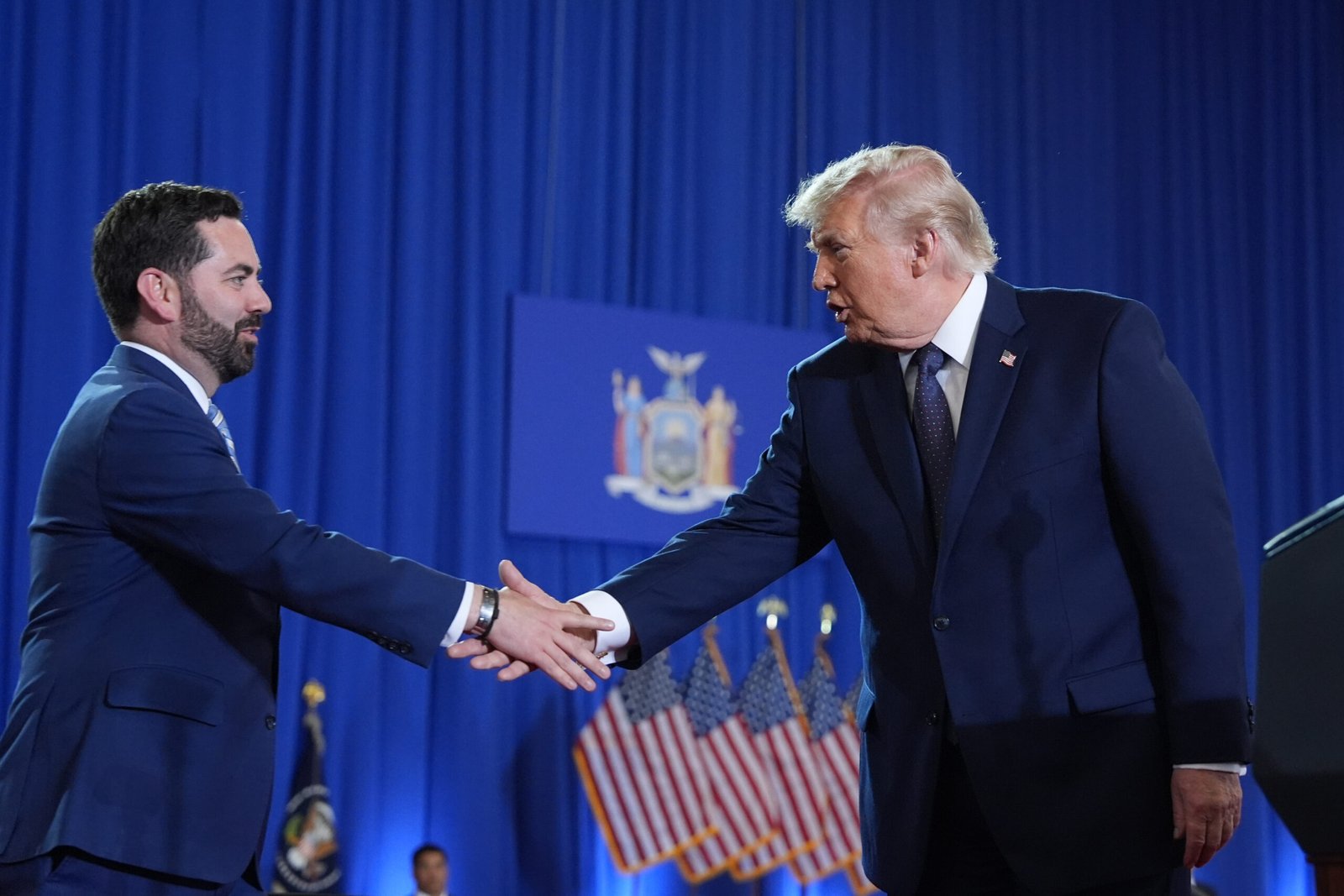
NEW YORK — Not too long ago, Republicans were salivating at the thought of using New York City Mayor Zohran Mamdani as a far-left boogeyman. Instead, moderate Gov. Kathy Hochul has emerged as the GOP’s go-to foil.
As Hochul runs for a second term, Republicans are hoping her middling popularity will be a drag on Democrats in competitive down-ballot races. Some Democratic candidates, meanwhile, are keeping her at arm’s length — a sign they recognize the downside of appearing with a governor often linked to Albany’s reputation for high taxes and lax criminal justice laws.
“There’s not a Democrat in the party in a swing district who wants to be near her,” said a state Democratic official, granted anonymity to speak candidly. “Her numbers aren’t as bad as four years ago, but they’re certainly not good.”
The current state of play is one neither party fully planned for. Mamdani, a 34-year-old democratic socialist who campaigned on freezing rents and taxing the rich, was supposed to be the Democrat who repelled suburban and upstate voters. Hochul has spent four years trying to be the Democrat who repels no one. Yet outside the city, the socialist is a curiosity and the governor a grievance.
After less than a year in office, Mamdani has amassed high favorability ratings in New York City and a positive perception nationally, while the suburbs ringing the city remain cooler on him. Hochul is being invoked far more broadly. Since casting Mamdani as a socialist neophyte carries less weight farther outside the city, Republicans have fixed their sights more squarely on her as the prime personification of the state’s leftward lurch.
New York, home to a handful of swing districts expected to determine control of the House, remains a high priority for both parties. And the top-of-ticket race between Hochul and Republican nominee Bruce Blakeman stands to impact voter turnout in races beyond their own.
“Outside of the New York City media market, Mamdani doesn’t have the same impact,” said Marc Molinaro, a former House lawmaker and ex-Trump administration official who’s now running for the state Assembly. “Most people further north just don’t have a relationship with the city. They may not love the city, they may not have an attachment to the city, but who do they see? They see the governor.”
On suburban Long Island, former state Assemblymember Mike LiPetri used his first television advertisement of the general election to decry “career politicians like Kathy Hochul and Tom Suozzi who sold us out and left us behind.” The opening screed in Rep. Nick LaLota’s TV spot is that “Kathy Hochul’s taxes are the worst in the nation.” And GOP candidate Anthony Constantino, running to succeed Rep. Elise Stefanik in a blood red upstate district, has accused his Democratic foe Blake Gendebien of being “beaten into submission” by the governor after he pulled a TV ad pledging to stand up to her.
In a statement, Hochul spokesperson Ryan Radulovacki said: “No amount of GOP spin changes the fact that New York Republicans gutted Medicaid, ripped food assistance from families and kids, and enabled Donald Trump, a historically unpopular president, as he tried to defund the NYPD and raised costs on everything from gas to groceries – while Governor Hochul put money back in New Yorkers’ pockets, passed free school meals, and stood up to Trump at every turn. Voters across this state see all of that, and they’re going to send Republicans a message in less than 50 days.”
Republicans are facing a tough midterm election with an unpopular president in the White House. They are trying to weather a political dynamic featuring widespread voter angst over costs, with high interest rates and spiking gas prices emerging as resonant plotlines in the Empire State. Losses in purplish and even red areas of New York would go a long way to costing Republicans the House.
Making Hochul the face of a Democratic Party framed around taxes and crime is meant to counter an otherwise bleak Republican environment and President Donald Trump’s unpopularity here.
But Democrats are casting doubt on how effective such messaging will be — especially compared to the GOP candidates’ association with Trump.
“I don’t think it’s anywhere near as potent as the president of the United States,” said consultant David Carlucci. “It is just a lash out as really one of the few options they have in terms of just playing the blame game.”
Meanwhile, Democrats are trying to thread a delicate needle as the governor seeks a second full term. Some are attempting to separate themselves from Hochul — a dance made all the more awkward as she marshals the resources of the New York Democratic Committee to aid down-ballot candidates.
In the North Country, Gendebien told supporters recently that Hochul is “unpopular” and “underwater” in the district he’s seeking to represent. According to a recording of a Sept. 3 town hall that was obtained by POLITICO, he also acknowledged that he didn’t know why.
Even in races where a high-profile surrogate could be a welcome boost to a relative unknown, the desire for the governor to stump isn’t necessarily strong. When asked if Hochul would be helpful on the trail for him, Mike DeCillis, a long shot Democrat challenging Rep. Nicole Malliotakis, replied: “Probably not.”
The district, a red-leaning seat that covers all of Staten Island and part of Brooklyn, is a “fickle pickle,” he said. “It’s not because of any specific policy. It’s the person they have been kind of trained and told that this is the person they shouldn’t like at all costs.”
Hochul’s zealous push for House Democrats — a years-long project launched after former House Speaker Nancy Pelosi blamed her weak showing in 2022 for losing down-ballot races — has further raised the stakes in a race that she’s largely expected to win. In 2022, she won by only 6 points.
“We’re going to be the state that sends Hakeem Jeffries to the speaker’s office,” Hochul said in an interview on NY1, highlighting her investment into the state party. She expressed confidence in flipping districts held by Rep. Mike Lawler, Lalota and Stefanik, and holding those represented by Suozzi and Reps. Laura Gillen, Josh Riley, Pat Ryan and John Mannion.
It’s unclear where exactly Hochul will stump for down-ballot candidates in the closing stretch of the election, though an aide said she will be supporting candidates up and down the ballot.
Republicans viewed Mamdani, of all people, to be their primary weapon in the suburbs and upstate, where voters tend to be moderate and more willing to back a Republican. But the mayor, who was viewed favorably by 69% of New York City voters in an August Siena Research Institute poll, has not been the beat-up toy many GOP candidates expected.
New York City mayors, who often bring left-leaning agendas into office, are typically viewed as easy targets for Republicans, especially in rural and suburban House districts. That strategy hasn’t always been effective, in part, because few voters outside the five boroughs consider the city’s mayor to be especially relevant.
“I’ve been asked many times, like, where does upstate and downstate start?” Republican state Sen. Peter Oberacker, who’s challenging Democratic Rep. Josh Riley, said in an interview last month. “You could almost determine where that line is by the concern about Mamdani. … In the more northern reaches of our district, it’s definitely a topic of discussion and concern. But as you come farther downstate, it gets a bit more intense.”
When asked whether the governor or mayor comes up more in discussions with voters, he said the former — and pointed to Hochul allocating $4 billion to help the city’s budget gap. “They feel this way that they’re not getting represented,” he said.
Riley doesn’t view Hochul as much of an issue. He touted her work tackling a dearth of affordable child care. “I’m eager to continue working on that with her,” he said in a statement.
In a state where Democrats hold all levers of power, Hochul is an obvious focal point for Republicans — the embodiment of a deep blue state’s policies on taxes, crime and regulations that drive up utility bills.
She’s tried to reverse that perception. She’s backed measures to scale back a controversial cashless bail law and touted middle-income tax cuts and rebate checks. And she’s embraced popular policies like expanding no-cost child care, banning cellphones in schools and a moratorium on data center construction.
But those policies are more popular than the governor herself.
The Siena survey found 49% of voters hold an unfavorable view of Hochul, with only 46% reporting a favorable opinion. Yet most voters back her efforts to curb Trump’s aggressive deportation campaign and New York’s data center construction pause, which Hochul rolled out this summer. The same poll found Hochul leading Blakeman by 10 points, with the largest chunk of her support coming from the city. She trailed Blakeman in the suburbs by 8 points, and they were nearly tied upstate.

Trump is even more unpopular with New York voters: Only 38% have a favorable view of him. He was slightly above water in the suburbs, but viewed unfavorably upstate and in NYC.
Despite those numbers, some Democratic candidates may not have much of a choice but to accept Hochul’s help.
The governor is using the state Democratic Committee this year to aid down-ballot candidates, opening field offices and providing political infrastructure to support those running in crucial races. This coordinated campaign is a stark departure from prior years when the state party functioned solely as an arm of the governor’s political operation.
The shift began in 2024 and is carrying over into this election year, as Democrats try to hold several seats on Long Island and in the Hudson Valley.
“She absolutely delivered in 2024 on this in a huge way,” said Rep. Pat Ryan, whose seat is not seen as competitive as it was two years ago. “She campaigned a bunch of times for me in that race and across the Hudson Valley and I dramatically outperformed in large part because of a lot of the things that she did. That’s only grown stronger now.”
New York Democrats must win without relying solely on Hochul’s coattails to carry them, though.
Distance themselves too far from the governor, and candidates run the risk of undermining the head of their party set on returning to Albany with a clear mandate for the next four years. Running too close with Hochul opens up swing seat candidates to Republican attacks that they’re the lackeys of a chief executive with so-so polling.
Ryan’s neighboring House member, Lawler, is viewed as one of the most vulnerable Republicans in the country. Earlier this year, he rallied with Trump — not the most popular figure in the district — and said he’d welcome Hochul to campaign for his Democratic opponent Cait Conley “any day of the week.”
In 2024, then-Vice President Kamala Harris narrowly carried the district, as Lawler won reelection.
With that past as prologue in mind, it remains unclear if Conley will appear with Hochul on the trail. But she’s bringing in other reinforcements. Former Transportation Secretary Pete Buttigieg, a potential 2028 presidential contender, campaigned with her in the district this week.
Conley has said outright that she does not want to campaign with Mamdani — a calculus that speaks to the independent-minded voters she needs to get on her side. Republicans have sought to tie them together in an attempt to portray her as too far to the left.
Lawler has repeatedly invoked both Mamdani and Hochul on the trail. At times, he’s trained more of his ire at the governor than his actual opponent.
“Their numbers are very similar in the district, and for different reasons and in different ways, they are equally as offensive to most voters in the district,” Lawler said of Hochul and Mamdani.
Still, Hochul’s allies believe it’s an error for Democratic candidates to disassociate themselves from the de facto head of the party. If she wins in November, she’ll continue to wield substantial power.
“I’ve never felt that running away from the head of your ticket is a winning strategy for any party in any year,” New York Democratic Party Chair Jay Jacobs said. “You make a mistake by distancing yourself from her where she can be helpful.”
House Republicans have left Washington for a seven-week pre-midterms recess — but not before showing some nerves about the rising cost of living heading into Election Day.
Several last-ditch attempts to tackle affordability concerns were on display this week: Seven Republicans broke party ranks and voted to rebuke the war in Iran launched by President Donald Trump. Other GOP members unsuccessfully sought an 11th-hour vote on suspending the federal gas tax. And one of the final House votes of the week was on a bill designed to curb utility costs related to data centers.
Many Republicans acknowledged the economic headwinds they are facing with the Iran conflict pushing gas and diesel prices to record territory in some parts of the country — plus growing anxiety about AI infrastructure increasing electric bills and a new Fed interest rate hike weighing on borrowing costs.
Among them was Rep. Rich McCormick (R-Ga.), who said in an interview he is expecting a “close” election and understands why many of his GOP colleagues wanted more action.
“This is about the time where people start paying attention,” he said. “And there’s only so much you can control.”
Rep. Mike Simpson (R-Idaho) warned Friday that “you can’t deny what people feel.”
“We make a mistake if we go and say the fundamentals of the economy are great — and they really are,” he said. “But that doesn’t help if you can’t afford gas or you can’t afford groceries or you can’t afford a new house.”
House GOP leaders, however, have been caught in a pickle: They acknowledge that Americans are feeling economic pain but they have been hamstrung in acting on those concerns by their thin majority, internal policy divides and Trump’s insistence that “affordability” is a Democratic “hoax.”
Rather than make law this summer, they have had to instead make excuses — blaming the Senate, congressional Democrats and Trump’s predecessor — while insisting some progress on prices has been made.
“We’ve been working with the president to make life more affordable for working families, and we’re not finished,” House Majority Leader Steve Scalise said in a Thursday interview, calling the cost of living the “No. 1 issue in America.”
“There’s a lot more work to do, but … it’s easy to forget the mess that we inherited,” he continued. “As much as I’d like gas prices to be lower, they’re lower today than where they were at the peak under [President Joe Biden], and they’re going to get lower when Iran gets resolved.”
Speaker Mike Johnson said at a Wednesday news conference that Republicans are providing “answers” to the question of how to lower the costs of everyday goods.
“There are a lot of creative ideas,” he said. “Even this week, the Republicans are the ideas party, and we’re constantly coming up with new and innovative things to continue to work to bring down the cost of living and work on the affordability issue.”
Implementing those ideas, however, is another matter. A group of ultraconservative members led by Rep. Andy Harris of Maryland led the push to suspend the federal fuel tax — 18.4 cents per gallon of gas and 24.4 cents per gallon of diesel — for the few months around Election Day.
“Enough is enough. Americans are paying more at the pump, and Washington shouldn’t be making it worse,” Harris said in a post on X.
Harris withheld his support on a key procedural vote to force a discussion around putting his bill on the floor, but it ran into opposition from fellow Republicans concerned about draining the main federal fund that finances highway projects. Many were also wary of exposing themselves to charges of hypocrisy: Some, including Harris, had previously opposed the idea under the Biden administration.
Later that day, seven Republicans voted for a Democratic resolution to rein in Trump’s authority over the conflict in Iran — three more than any previous Iran war powers vote. Two of them, Reps. Zach Nunn and Mariannette Miller-Meeks, represent Iowa, where the agriculture industry has been hammered by spiking fuel prices.
“I will not vote to keep our soldiers in an open-ended war, with Iowans paying too much at the pump,” Miller-Meeks said in a statement after the vote. Later that day, another Iowan — Rep. Ashley Hinson, who is running for Senate — announced she would not join Vice President JD Vance at an in-state rally Friday, citing a scheduling conflict.
The third new GOP vote on the Iran measure, Rep. Nancy Mace of South Carolina, also cited the “financial consequences” of the war in a BLN interview: “I voted my conscience.”
Mace, who is not returning to Congress next year after a failed bid for governor, was more blunt in comments to reporters at the Capitol, saying she believed the GOP would lose its majority in part due to the war.
“The midterms are going to be a fucking bloodbath,” she said.
GOP leaders did orchestrate an overwhelmingly bipartisan 417-3 vote on the Ratepayer Protection Act, which is aimed at ensuring data centers do not lead to higher overall utility costs — though many of its provisions are voluntary.
Still, Johnson touted its passage as a coup that would help voters feel some relief.
“Americans will not split the bill for the buildout of data centers or AI infrastructure anywhere in their communities,” Johnson said after the bill’s passage. “Notice how quiet Democrats are now that Republicans have taken action on all this.”
While almost every Democrat supported the bill, they are also calling it a fig leaf that is unlikely to materially improve the cost of living.
House Minority Leader Hakeem Jeffries called it a “step forward” but that “more clearly needs to be done.” Sen. Martin Heinrich of New Mexico, the top Democrat on the Senate Energy and Natural Resources Committee, blocked its swift passage in the Senate Thursday, calling for “real legislation with real teeth.”
“There are way stronger proposals, and I don’t really think that this one is going to come off as much of a win for the Republicans who are flailing to hold on,” said Rep. Greg Casar (D-Texas), chair of the Congressional Progressive Caucus, in an interview.
- Spanberger slaps new guardrails on data centers
- Hill investigates after F-35 parts diverted to Hong Kong
- As data center backlash grows, another GOP governor draws a line
- Capitol agenda: High costs hound GOP as House exits
- Republicans wanted to run against Mamdani. They’re running against Hochul instead.
- Bill Cassidy slams RFK Jr. over measles outbreaks but demurs on confirmation vote
- Senate roadblock sparks new competition over data center bills
- Economic nerves emerge as House Republicans call it quits till Election Day
- Bill Cassidy on vaccines, RFK Jr. and the fight for public trust

- Urgent motion filed to stop carving of Trump’s name into US Institute of Peace building
-

 Politics2 years ago
Former ‘Squad’ members launching ‘Bowman and Bush’ YouTube show
-
Uncategorized2 years ago
Bob Good to step down as Freedom Caucus chair this week
-

 Politics2 years ago
Former Kentucky AG Daniel Cameron launches Senate bid
-

 The Josh Fourrier Show2 years ago
DOOMSDAY: Trump won, now what?
-

 The Dictatorship2 years ago
Luigi Mangione acknowledges public support in first official statement since arrest
-

 The Dictatorship2 years ago
Pete Hegseth’s tenure at the Pentagon goes from bad to worse
-

 Politics2 years ago
Blue Light News’s Editorial Director Ryan Hutchins speaks at Blue Light News’s 2025 Governors Summit
-

 The Dictatorship1 year ago
Mike Johnson sums up the GOP’s arrogant position on military occupation with two words