
Congress
Capitol police report spike in threats made toward lawmakers in 2025

Threats toward members of Congress, their families, staff and the Capitol complex surged in 2025, according to the U.S. Capitol Police, with over 5,000 more incidents reported than the previous year.
The police force’s Threat Assessment Section investigated 14,938 “concerning” statements, behaviors and communications, the agency said in a news release this week.
It’s a sharp increase from 2024, when 9,474 threats were investigated by USCP. These threats — which include everything from social media posts to more direct targeting of lawmakers — mark the third year in a row that USCP has seen an increase in the number of threats made.
As the number of incidents continues to rise, Capitol Police Chief Michael Sullivan said in a statement that USCP has been “strengthening” its partnerships with law enforcement agencies across the country so members can remain safe when they are away from Capitol Hill.
“We want to make sure agencies have the resources they need to be able to enhance protection, which is critical to the democratic process,” Sullivan said.
In recent years, the nation has seen an increase in political violence, with some targeting members of Congress.
On Tuesday, a man was arrested after charging Rep. Ilhan Omar (D-Minn.) and spraying her with an unknown substance during a town hall.
In September, conservative activist Charlie Kirk was killed while speaking at a college campus. Last summer, a gunman shot two Minnesota state lawmakers, killing one. Two months before that, an arsonist set fire to the Pennsylvania governor’s mansion while Democratic Gov. Josh Shapiro and his family slept inside. And during the 2024 presidential campaign, a gunman shot President Donald Trump at a political rally during an attempted assassination.
USCP on Wednesday said one of the best ways to combat the number of threats facing legislators around the country is to decrease violent political rhetoric — a sentiment both Democrats and Republicans have been urging their counterparts to do each time violence breaks out.
As Capitol Police continue to monitor threat assessments, the department has expanded its Protective Intelligence Operations Center, which launched in 2024 as a way to process reports regarding the safety of the legislators. The 24/7 center works with the House and Senate Sergeant at Arms to monitor members’ safety, the agency says.
“We, and both Sergeant at Arms, are seeing an increase of reporting through our outreach efforts with the Congressional Community,” said Jeanita Mitchell, acting assistant chief of police for protective and intelligence operations.


The Congressional Black Caucus is emphatically declaring its support for House Minority Leader Hakeem Jeffries — and denouncing Sen. Elissa Slotkin’s call for new leadership in Congress.
In a statement posted to social media on Friday, the entirely Democratic CBC declared that it stands united behind the nation’s first Black minority leader of the House. The caucus accused the Michigan senator of “posturing for higher office in 2028” and called attention to her votes to approve multiple members of President Donald Trump’s Cabinet.
“House Democrats don’t need a lesson on reading the political moment from someone who handed Donald Trump one of the most corrupt Cabinets in American history,” the CBC said. “Voting to confirm Kristi Noem, Pam Bondi, and five other Trump Cabinet secretaries is not the posture of someone who understood the moment’ after 2024.”
The CBC closed its defense of Jeffries with a sharp parting shot of remaining focused on providing for Americans rather than “engaging in distractions that only serve to divide Democrats at a moment when unity and resolve are essential.”
A spokesperson for Slotkin, who has repeatedly called for a new generation of leadership in Congress, did not immediately respond to a request for comment.
The Commerce Committee’s top Democrat Maria Cantwell (Wash.) and Sen. Richard Blumenthal (D-Conn.) warned House lawmakers against advancing their chamber’s version of the Kids Online Safety Act, arguing it would face intense lobbying from tech companies in the Senate and risk unraveling years of bipartisan work.
“If it is passed by the House it will come to the Senate,” Blumenthal, the bill’s Senate cosponsor, told reporters at a Friday press briefing. The Connecticut Democrat said he is concerned senators will be influenced by the tech industry’s “armies of lawyers and lobbyists” who may “confuse and exploit” misunderstandings about a House bill with the same name as a Senate version but excludes key provisions, such as the “duty of care.” (This concept requires online companies to design social media platforms with an eye for children’s safety.)
“We’re not going to let bad legislation with a good title just get across and think somebody’s done something,” Cantwell said.
The House version of KOSA — which is included in the KIDS Act, a revised bipartisan package that the Energy and Commerce Committee advanced along party lines in March — is scheduled to be considered on the House floor next week under suspension of the rules.
“We need to stop this bill in the House, and we need to prevent the White House from forming an alliance with Big Tech on this issue,” said Blumenthal, who characterized the version of KOSA that House leadership is pushing as a “sham.”
Both Democratic lawmakers also expressed concern that Senate Commerce Committee Chair Ted Cruz (R-Texas) could adopt the House version of KOSA in a kids’ safety package he has yet to publicly release but has pledged to markup by August recess. Cruz said “negotiations are ongoing” earlier this week when asked by Blue Light News whether he would be open to incorporating such changes put forward in the House.
Cruz’s package is expected to include KOSA as well legislation barring companies from using minors’ personal data for targeted advertising, banning kids under age 13 from social media, and providing greater oversight for how children interact with AI chatbots.
Although Blumenthal remains hopeful that Cruz will “stay true to his first vote in favor of KOSA,” which overwhelmingly passed in the Senate last Congress, the Connecticut Democrat said Friday he’s worried Cruz and others may be tempted to “take the bait” and abandon the bill’s basic principles.
Congress
Moderates beware: Mamdani coalition portends a dramatically different Democratic Party in NYC
NEW YORK — A coalition powered by Mayor Zohran Mamdani expanded the left’s reach Tuesday, winning younger voters across racial and ethnic lines and once again upending conventional wisdom about elections in New York City.
A series of hotly contested congressional and state elections pit a slate of Mamdani-backed democratic socialists and progressives against establishment candidates who, in several cases, differed little on policy aside from U.S.-Israel relations.
The results were staggering.
Midterm election cycles in deep-blue New York City tend to be sleepy affairs. Both this year and in 2022, just over 500,000 people cast ballots, less than 20 percent of eligible voters. But turnout within a congressional district spanning Upper Manhattan and the Bronx increased by roughly 50 percent between 2022 and Tuesday, with more than 66,000 voters heading to the polls.
In another seat covering parts of Brooklyn and Queens, turnout more than doubled from 2022, though state and federal elections were held on different days that year and the seat was not competitive, which would have reduced the number of voters going to the polls.
Congressional candidates backed by the Democratic Socialists of America were able to replicate the mayor’s success by winning younger Latino voters in Brooklyn and a majority of Black voters in Harlem. Combined with the DSA’s base in relatively wealthy neighborhoods, the result charted the far left’s broadening appeal and a potential reorientation of the electorate that will influence races for years to come.
“This was a big wave for DSA and they did a good job capitalizing on it,” said Evan Roth Smith, a pollster with Slingshot Strategies. “The question now is: Was this a wave cycle that will abate, or is it the start of the takeover?”
Much of Mamdani’s base is concentrated in the so-called “commie-corridor,” a series of neighborhoods along the Brooklyn-Queens waterfront filled with young, educated and affluent voters who’ve propelled several DSA candidates into office. They went gaga over Mamdani’s candidacy and, as Tuesday’s results show, will turn out for candidates he supports.
The area was crucial to Assemblymember Claire Valdez’s crushing 56-38 defeat of Brooklyn Borough President Antonio Reynoso.
“The factor that felt most significant to me were all of these New Yorkers who got activated and politicized in the mayor’s race last year who were looking for the next fight,” said Andrew Epstein, a political adviser to Mamdani who worked on Valdez’ campaign. “Those people didn’t go away. And they want to keep going.”
Valdez also won several heavily Latino areas that were expected to break for her opponent.
Reynoso was born in Brooklyn to Dominican parents and just a few years ago was a City Council member representing Bushwick, a long-gentrifying Brooklyn neighborhood that’s home to Latino families and young hipsters. Valdez was born in Texas, moved to New York City in 2015 and served in the state Assembly for just one term before launching her Mamdani-backed bid for retiring Rep. Nydia Velázquez’s seat.
She ended up winning areas of Bushwick by even greater margins than the total results — in some election districts winning upwards of 80 percent of the vote.
“You don’t win the district by 35 points if you don’t have broad advantages across age and demographic groups,” said Michael Lange, an election analyst and Mamdani supporter who has tracked several contested races with extreme granularity. “Is she blowing him out of the water with Hispanic voters under 50? I see tons of evidence that the answer is yes.”
The age advantage was the common thread across several other races.
In Upper Manhattan and the Bronx, for example, younger Black voters in Harlem were key to Darializa Avila Chevalier’s win over Rep. Adriano Espaillat, the chair of the Congressional Hispanic Caucus who had built a small political empire in the district.
While gentrifying, the neighborhood remains a seat of Black political power and is home to younger households who tend to rent. That particular demographic is a strong indicator of why Mamdani won the area in 2025, even as he lost the Black vote overall to former Gov. Andrew Cuomo, whose support was concentrated among older Black homeowners in Brooklyn and Queens.
While Espaillat never healed a rift with the Black community in upper Manhattan opened during his election in 2016, which contributed to his weak performance, Avila Chevalier demonstrated Tuesday that a significant share of voters there were not just supportive of Mamdani the person, but of the broader political movement he’s now leading.
Overall, she edged out Espaillat with Black voters 48-46, according to an analysis from The New York Times, which charted demographic breakdowns for several contested races.
Three winning congressional candidates endorsed by Mamdani — including former city Comptroller Brad Lander in Brooklyn, who unseated incumbent Dan Goldman — share several similarities. They won younger, college-educated and wealthier voters by huge margins, in several cases by 30 points or more, and lost lower-income voters to incumbents or candidates affiliated with incumbents — a sign that the movement seeking to boost struggling New Yorkers has not won them over.
While the DSA was able to win three state races without the support of Mamdani — a testament to the organizing prowess of the left that was essential to reactivating the mayor’s coalition — there were limits to the city’s leftward shift.
Rep. Grace Meng won her reelection race, though she only vanquished challenger Chuck Park by 14 points, an uncomfortable margin for an incumbent of her stature. Park, who ran to Meng’s left, was boosted by a huge turnout in Woodside, Queens, a multiethnic neighborhood that went heavily for Mamdani in last year’s mayoral race.
Elsewhere in the Bronx, however, incumbents remained strong. Rep. Ritchie Torres handily won reelection with 72 percent of the vote, though it was a low-turnout affair more consistent with an uncompetitive midterm. Nevertheless, House Minority Leader Hakeem Jeffries touted the results — even as he watched a series of his endorsed candidates fall to the DSA in Brooklyn, his home borough, in a preview of the intraparty battles to come.
“In some higher-income districts, there was an outsized focus on the Middle East. In other districts, for instance, in the South Bronx, Ritchie Torres ran against somebody who was heavily critical of his position on Israel, and he won by fifty points,” Jeffries told MS NOW on Wednesday.
- How the World Cup became a victory lap for Trump ally El Tigre
- Trump gets the complete domination he wanted in Louisiana
- Palestinian flags fly in Texas
- Trump-backed Letlow wins GOP primary for Sen. Bill Cassidy’s seat
- House panel subpoenas Leon Black, escalating tactics in Epstein investigation

- Congressional Black Caucus blasts Slotkin over her calls for new leadership in the House
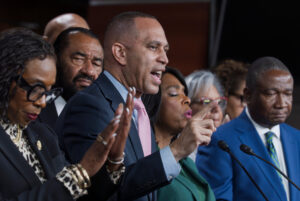
- Key Democrats urge House to reject kids’ safety proposal

- Moderates beware: Mamdani coalition portends a dramatically different Democratic Party in NYC
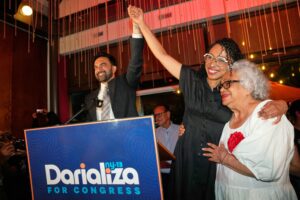
- Divisive Israel vote to be discussed on Sunday House Democrats call
- House panel subpoenas Leon Black, escalating tactics in Epstein investigation
-

 Politics1 year ago
Former ‘Squad’ members launching ‘Bowman and Bush’ YouTube show
-

 The Dictatorship1 year ago
Luigi Mangione acknowledges public support in first official statement since arrest
-

 Politics1 year ago
Former Kentucky AG Daniel Cameron launches Senate bid
-
Uncategorized2 years ago
Bob Good to step down as Freedom Caucus chair this week
-

 The Josh Fourrier Show2 years ago
DOOMSDAY: Trump won, now what?
-

 The Dictatorship1 year ago
Pete Hegseth’s tenure at the Pentagon goes from bad to worse
-

 Politics1 year ago
Blue Light News’s Editorial Director Ryan Hutchins speaks at Blue Light News’s 2025 Governors Summit
-

 The Dictatorship10 months ago
Mike Johnson sums up the GOP’s arrogant position on military occupation with two words