
The Dictatorship
New York backs casinos near Mets stadium and a Trump-linked golf course

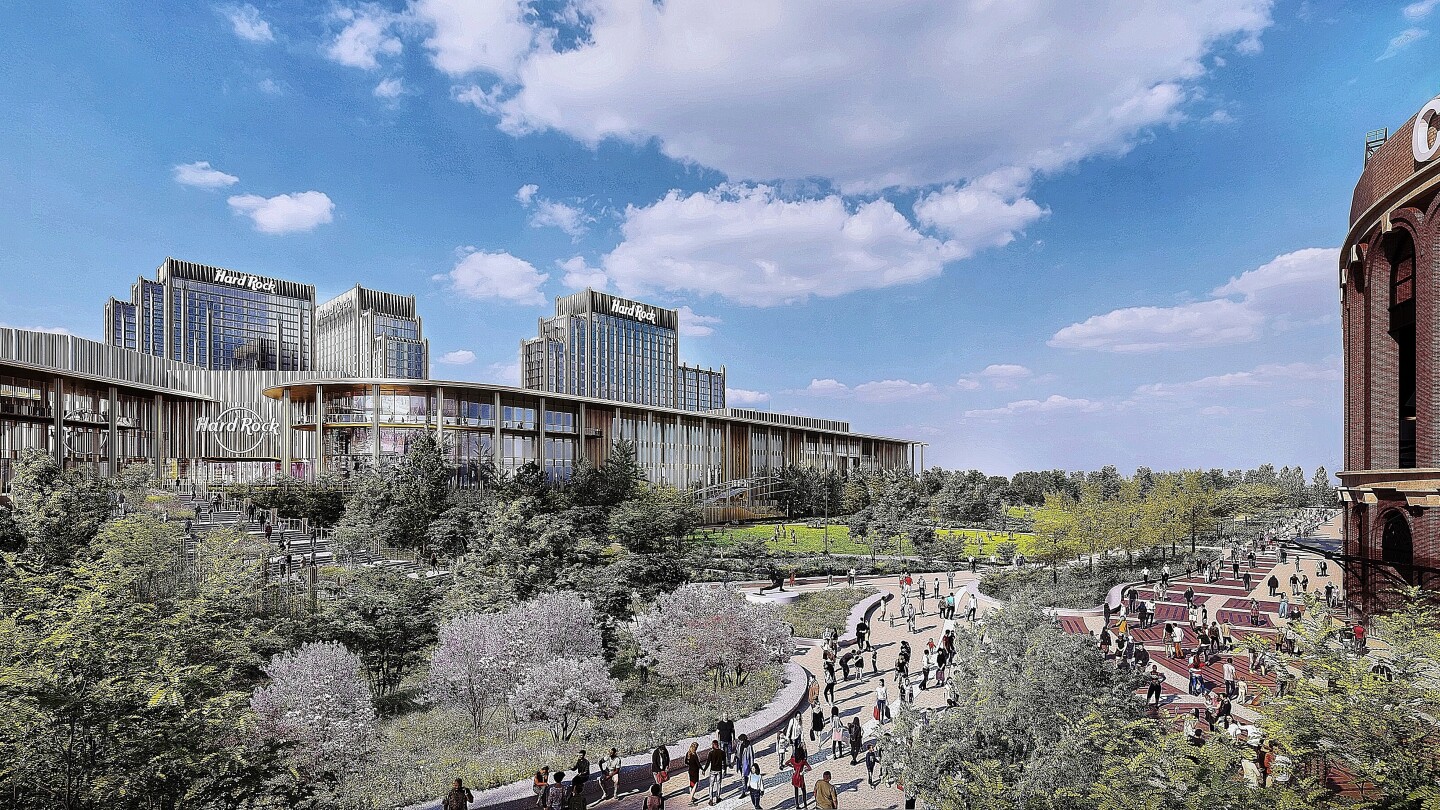

NEW YORK (AP) — New York City is poised to get its first Vegas-style casinosincluding one next to the home stadium of baseball’s New York Mets and another that could see a windfall for President Donald Trump.
Three casino proposals were approved by a key state panel on Monday for lucrative gambling licenses. No casinos will end up coming to Manhattan, however, as several other competing proposals were already scrapped, including one in backed by Jay-Z in the heart of Times Square.
The state Gaming Commission is expected to formally issue the licenses before the end of the year, as the gambling revenues are already factored into the state budget. Democratic Gov. Kathy Hochul praised the projects, saying they could unlock billions for the state’s transit system and create jobs. Opponents warn that easy access to casinos will increase gambling addiction.
Trump could receive $115 million tied to Bally’s $4 billion casino plan at the Ferry Point golf course in the Bronx. Bally’s purchased operating rights for the city-owned golf course from the Trump Organization in 2023 and agreed to pony up the additional money if it won a casino license. The Trump Organization did not reply to an email seeking comment.
In nearby Queens, billionaire Mets owner Steve Cohen proposed an $8.1 billion Hard Rock casino complex on a parking lot of Citi Field, including a performance venue, hotel and retail space. Resorts World proposed investing more than $5 billion to expand its slots parlor into a full casino at Aqueduct Race Track in Queens near John F. Kennedy International Airport with added hotel, dining and entertainment options.
Stay up to date with the news and the best of AP by following our WhatsApp channel.

The Gaming Facility Location Board said in its written decision that the region’s dense and relatively affluent population, combined with high tourism, would be able to support three full casinos in close proximity.
Its consultants, using conservative assumptions, estimated the casinos would generate a combined $7 billion in gambling tax revenues from 2027 to 2036, plus $1.5 billion in licensing fees and nearly $6 billion in state and local taxes. However, the board said the projects’ timelines are “ambitious.” The racetrack expansion aims to open some facilities by March, while the Citi Field and golf course projects target 2030 openings.
The commission is authorized to license up to three casinos in the New York City area after voters approved a referendum back in 2013 opening the door to casino gambling statewide. Four full casinosall upstate, now offer table games. The state also runs nine gambling halls without live table games, many of them also miles away from Manhattan.
Alan Woinski, a New Jersey-based gambling consultant, said the New York City market “should be deep enough” to sustain not just the three planned resort casinos but two other existing slots parlors just outside the city in Yonkers and on Long Island.
He cautioned that early financial projections often fall short, saying he hasn’t seen a casino hit its initial numbers in many years.
John Holden, a business professor at Indiana University who specializes in gambling law, said the market has no national comparison, making projections uncertain. He said he wasn’t surprising the panel recommended all three projects for licenses, given they all have deep resources and expertise.
Anti-casino protesters disrupted Monday’s meeting in Manhattan with chants of “Shame on you! Shame on you!” before they were escorted out.
Jack Hu, one of the group’s organizers, said the proposals will have a disproportionately negative impact in the city’s Asian American communities, which are largely concentrated in Queens. He said casino operators view older Asian adults and workers as merely “cash cows to milk for money.”
“They bus our seniors to casinos, and they give them meal and gambling vouchers in the hopes that they’ll stay long enough to lose their entire Social Security check,” Hu said after the meeting.
The closely watched competition for a New York City license began with a crowded field, with some eight proposals in the running as recently as September. But four of the high-profile plans failed to get the stamp of approval from local advisory boards, automatically knocking them out of contention. MGM abruptly pulled out of the license sweepstakes in October.



WASHINGTON (AP) — The Trump administration has acknowledged in court documents that it canceled $7.6 billion in grants for hundreds of clean energy projects “based solely on the political identity of the grant recipient’s state” — in this case, 16 states that voted for Democrat Kamala Harris in the 2024 presidential election.
The statement contradicts repeated assertions by Energy Secretary Chris Wright and other officials that the projects were canceled because they did not adequately advance the nation’s energy needs or had other problems that made them a poor investment of taxpayer dollars.
Democrats and environmental groups seized on the court filing Friday, saying the administration had “weaponized” the federal government to kill good jobs and punish working families because of their political views.
Democrats say what was ‘obvious’ has now been acknowledged
“This administration has now admitted in court what has long been obvious: it terminated nearly 300 cost-cutting energy projects for no reason other than the fact that the states they were in did not vote for the president in the 2024 election,” said Rep. Marcy Kaptur of Ohio and Sen. Patty Murray of Washington state. Both are high-ranking Democrats on the House and Senate Appropriations committees, respectively.
“Weaponizing the federal government like this is outright un-American, and it’s hardworking families already struggling with sky-high costs who are suffering the consequences of this corrupt abuse of power,” Kaptur and Murray said.
They called on congressional Republicans to join them in holding the Trump administration “accountable for the President’s failure to look out for all Americans.”
The Energy Department announced last October that 321 funding awards across 223 projects were terminated, saying that after review, they “did not adequately advance the nation’s energy needs or were not economically viable.”
The cuts, part of broader attacks from President Donald Trump on climate programs and clean energy funding, slashed federal support for projects to build battery plants, develop hydrogen technology, upgrade the electric grid and capture carbon dioxide emissions.
Russell Vought, the White House budget director, highlighted the cutbacks in a social media post, saying money “to fuel the Left’s climate agenda is being cancelled.”
The Energy Department did not immediately respond to a request for comment.
Projects from many states were cut
Projects that were cut were located in California, Colorado, Connecticut, Delaware, Hawaii, Illinois, Maryland, Massachusetts, Minnesota, New Hampshire, New Jersey, New Mexico, New York, Oregon, Vermont and Washington state. All 16 targeted states supported Harris, but Wright said the cuts were “business decisions” based on whether the projects were a good use of taxpayer money or not.
The cuts were immediately challenged in court, and more than two dozen Democratic members of Congress, led by California Sens. Adam Schiff and Alex Padilla and Rep. Zoe Lofgren, wrote a letter to the Energy Department’s acting inspector general requesting a formal investigation. The department’s internal watchdog launched an investigation in December.
Government lawyers had p reviously confirmed in a court filing late last year that the selection of grants in fact “was influenced by whether a grantee’s address was located in a State that tends to elect … Democratic candidates in state and national elections (so-called “Blue States”).”
That filing came in a separate suit filed by clean energy groups and the city of St. Paul, Minnesota, over the canceled funding. The most recent admission came in a case called Thakur v. Trump that’s been ongoing since last spring. Federal lawyers acknowledged that they used keywords related to diversity, gendervaccine hesitancy and COVID-19 to screen for projects that ran afoul of the Trump administration’s priorities.
Holly Bender, chief program officer for the Sierra Club, said the latest court filing shows “the Trump administration is brazenly admitting to a vindictive approach to cancelling much-needed energy infrastructure that ignores the job losses, air pollution and increasing bills that people are experiencing everywhere.”
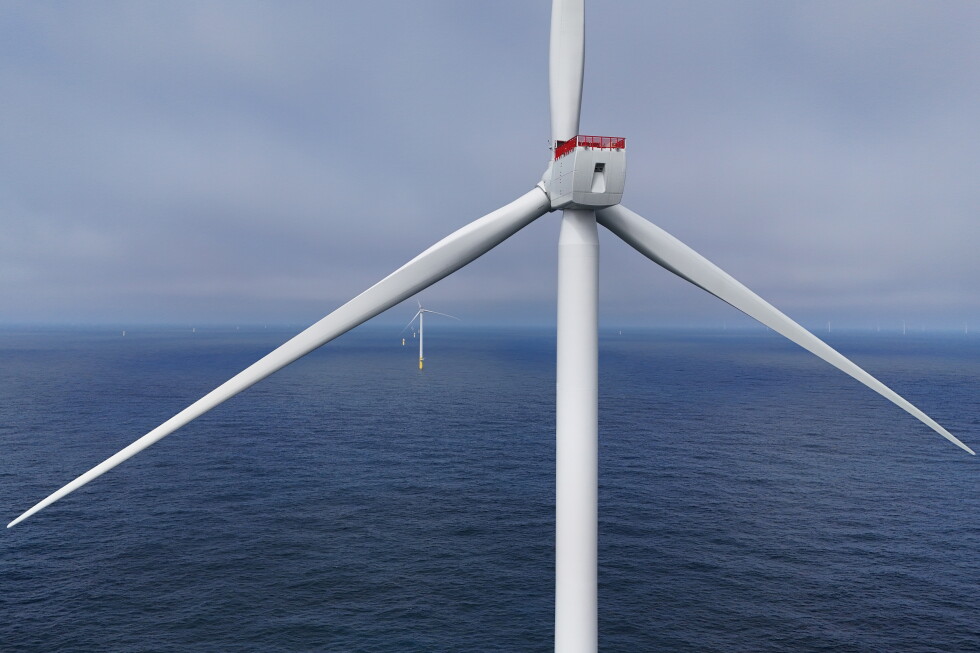
Instead of “building the energy projects we desperately need,” billions of American taxpayer dollars are “going to line the pockets of a small handful of fossil fuel company CEOs,” Bender said, citing nearly $3 billion pledged by the Trump administration to cancel offshore wind projects in favor of fossil fuel projects such as natural gas and coal.
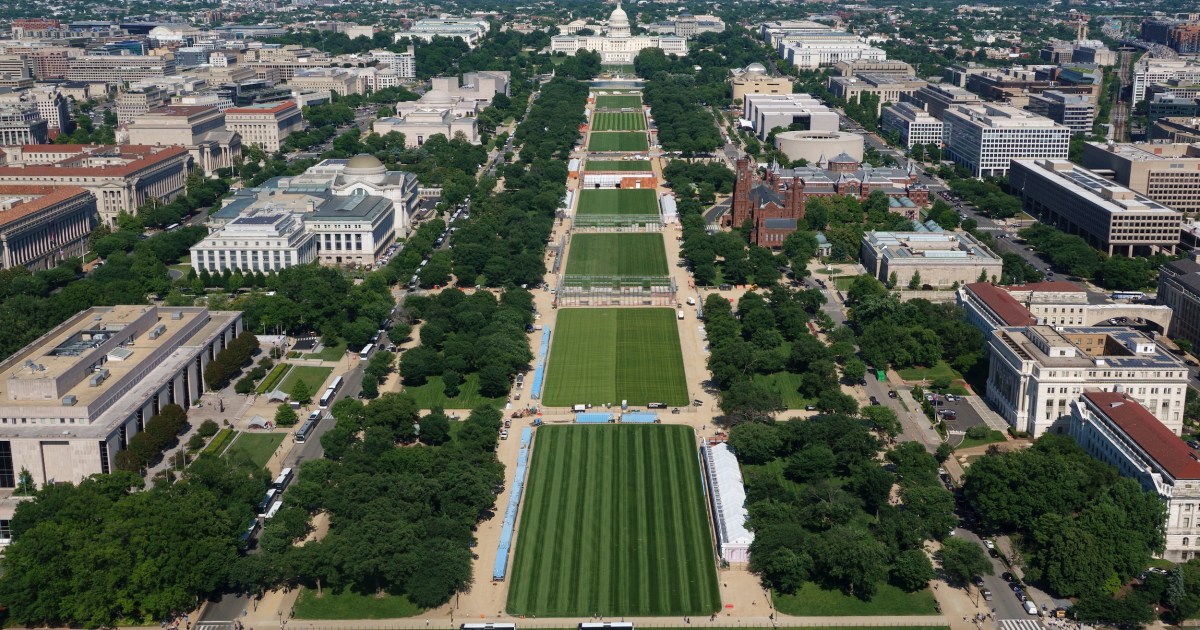
If President Donald Trump gets his way, the first thing visitors to the Smithsonian’s National Museum of American History will be greeted with are signs warning them that because of “inaccurate information presented in the Museum” they should seek “accurate information” elsewhere.
The president on Friday ordered the installation of temporary “warning” signs on the museum’s sidewalks, marking a major escalation in his campaign to pressure the Smithsonian Institution to rewrite American history to better align with his administration’s ideology.
The executive order directs Interior Secretary Doug Burgum, Office of Management and Budget Director Russell Vought and several other Cabinet officials to utilize “all available authorities to encourage” the Smithsonian Institution to “correct the issues found” in a scathing White House reportreleased on July 4 that accused the museum of “extreme political activism” and claimed it “cannot be trusted to tell America’s story honestly and in a way that is inspiring, unifying, and worthy of our great republic.”
The sidewalks and walkways outside of the popular museum, which welcomes just shy of two million visitors annually, are federal property controlled by the National Park Service. The signs would “notify visitors that the Museum exhibits should be renovated consistent” with the findings of the July 4 report. They would also “direct visitors to locations and resources for accurate information regarding America’s history.”
Trump also accused the museum of failing to “to appropriately honor the 56 signers of the Declaration of Independence during this 250th anniversary year of the founding of our country,” and instructed Burgum to install “temporary exhibits” on Smithsonian walkways to correct “inaccurate information presented in the Museum.”
“The Report demonstrates that the Smithsonian leadership does not present American history as a shared national inheritance to be taught and celebrated, but instead views American history as a ‘prime tool’ to advance ideas of social justice and the radical transformation of our society,”according to the newly signed executive order.
The signage order followed a week of congressional testimony by Smithsonian officials in hearings called by House Republicans in response to the White House report. Anthea Hartig, head of the National Museum of American History, was grilled over her patriotism and dedication to country.
Hartig said the White House report “does not fairly characterize the full body of work of this museum.” And under questioning from GOP lawmakers she reaffirmed her allegiance to her country multiple times, at one point answering, “I love this country unconditionally.”
The report, oversight hearings and signage demand compound more than a year of the Trump administration’s pressure campaign against the world’s largest museum, education and research complex. In March 2025, Trump signed an executive order that vowed to strip federal funding from Smithsonian programs that present what he viewed as “improper, divisive, or anti-American” ideology.
The Trump administration has since threatened to withhold federal funding from the Smithsonian Institution unless a number of its museums submit documentation for an expansive content review.
Sydney Carruth is a breaking news reporter covering national politics and policy for MS NOW. You can send her tips from a non-work device on Signal at SydneyCarruth.46 or follow her work on X and Bluesky.
As his new tariffs went into effect and gas prices climbed on Saturday, President Donald Trump said he’s not ruling out a full-scale war.
In a phone interview with French journalist Sonia Dridi, Trump said he’s “absolutely” considering resuming full-scale war with Iran if the U.S. doesn’t “get 100% of what we want.”
The president told reporters in the Oval Office on Friday the U.S. is “talking” to Iran, adding that he believes Iran is “getting more and more serious as the days go by” but “that doesn’t mean we get there.” Friday night was the first in 13 consecutive nights that the U.S. did not strike Iran.
The national average gas price rose slightly Saturday to $4.11 a gallon as Trump’s newly imposed tariffs on goods from more than 80 countries threatened to heap further financial strain on Americans ahead of the midterms. The reporter said when she asked Trump whether he would follow through with his threat to levy “substantial” new tariffs on the European Union, which he has accused of “robbing” American tech companies, he declined to comment.
The tariffs, which took effect Friday and have already been challenged in court, could cost American households an extra $1,100 annually, according to an analysis by The Budget Lab at Yale University. That comes at a time when consumers are already shelling out more for necessities, including gas and groceries, as the Iran war drives inflation and energy prices upward.

Gas price averages in the United States surpassed $4 a gallon on July 20 for the first time in more than a month as fighting in the Iran war escalated following the collapse of a temporary ceasefire agreement between the U.S. and Iran, which the White House billed as a significant step toward substantial nuclear negotiations and a permanent peace deal.
With the war soon to enter its sixth month, there has been little public progress on an agreement between Washington and Tehran to open the Strait of Hormuzthe vital trade waterway that has become a major source of contention since the war began on Feb. 28. Iran declared the strait closed “until further notice” earlier this month, and the U.S. military’s bid to forge an alternate route for shipping oil and other goods along Oman’s coast has been hamstrung by new threats.
In the middle of it all, Americans are feeling the pain.
More than half of Americans reported feeling more stressed about their finances than they were one year ago in a quarterly CNBC and SurveyMonkey survey released last week. Optimism for a better financial outlook was low, too, with half of Americans reporting they believe the U.S. economy will worsen over the next year because of international turmoil, government policy and the rising cost of living.
Patience with the economic cost of the president’s military campaign in Iran has slipped in recent polling, even among Trump’s most ardent supporters, with 37% of self-identified MAGA Trump voters saying the U.S. should only continue the war if it does not further increase costs, according to a POLITICO poll published on July 22. In May, half of Trump’s base thought the war was worth its economic costs.
While the White House has taken steps to address the prices at the pump as the midterms approach, Trump himself has so far done little to publicly address the financial pain Americans are feeling.
And his latest effort to resurrect his global tariff regime following the Supreme Court’s February strike down of his “liberation” day tariffs threatens to add insult to injury. The latest tariffs apply to countries that make up 99.4% of U.S. trading partners. Brought under Section 301 of the Trade Act of 1974, which enables the government to levy import taxes in response to unfair trade practices, the tariffs range from 10% to 12.5%.
The Liberty Justice Center, the legal nonprofit that represented the plaintiffs in the successful challenge of Trump’s International Emergency Economic Powers Act tariffs, is leading a new lawsuit challenging his authority to levy the Section 301 tariffs.
Emily Hung contributed to this report.
Sydney Carruth is a breaking news reporter covering national politics and policy for MS NOW. You can send her tips from a non-work device on Signal at SydneyCarruth.46 or follow her work on X and Bluesky.
- Senate adding Iran sanctions to Russia bill
- Senate adding Iran sanctions to Russia bill
- Abortion opponents have a new weapon in their fight for pill bans: wastewater data
- Trump administration admits canceling grants based on politics

- Senate adding Iran sanctions to Russia bill
- Comer: 1 NDA produced by Leon Black to House Oversight ‘unacceptable’
- Inside Trump officials’ quiet maneuvering in Louisiana’s redistricting shakeup
- Trump to Senate GOP: Adopt budget blueprint before August break
- Senate adding Iran sanctions to Russia bill
- Appeals court upholds injunction on President Trump’s mail-in voting order
-

 The Josh Fourrier Show2 years ago
DOOMSDAY: Trump won, now what?
-

 Politics1 year ago
Former ‘Squad’ members launching ‘Bowman and Bush’ YouTube show
-

 The Dictatorship1 year ago
Luigi Mangione acknowledges public support in first official statement since arrest
-
Uncategorized2 years ago
Bob Good to step down as Freedom Caucus chair this week
-

 Politics1 year ago
Former Kentucky AG Daniel Cameron launches Senate bid
-

 The Dictatorship1 year ago
Pete Hegseth’s tenure at the Pentagon goes from bad to worse
-

 Politics1 year ago
Blue Light News’s Editorial Director Ryan Hutchins speaks at Blue Light News’s 2025 Governors Summit
-

 The Dictatorship11 months ago
Mike Johnson sums up the GOP’s arrogant position on military occupation with two words