
Congress
‘Utterly shameful’: Congress to crush US record this week for longest shutdown

Congress is on track this week to break an unflattering record: presiding over the longest government shutdown in U.S. history.
The ongoing funding lapse will hit the 35-day mark Tuesday night, eclipsing the partial shutdown that ended in early 2019 and also occurred under President Donald Trump.
Bipartisan talks among rank-and-file senators are underway, which could thaw the weekslong freeze between the two parties. Lawmakers over the weekend were confronted with the grim reality that millions of Americans could lose SNAP food aid — as well as more closures of early education centers, shortages of air traffic controllers and first glimpses of higher health care premiums as Obamacare subsidies are set to expire.
But there’s little chance members of Congress will be able to cobble together a deal to reopen the government before their partisan stalemate clears a new milestone. Even if an agreement quickly materializes in the Senate, lawmakers aren’t scheduled to return to the Capitol until Monday night, and Speaker Mike Johnson has told House members they will get 48 hours notice before they need to be back in Washington to vote on any bill.
“Shameful, utterly shameful, that the Democrats are making history in this way,” Johnson said in an interview Friday. “I honestly did not believe they would have the audacity to inflict this much pain on the people and show no regard for it whatsoever.”
Tuesday is also Election Day in several states, with both parties closely watching the outcomes in the gubernatorial races in Virginia and New Jersey, as well as the mayoral contest in New York City and a congressional redistricting referendum in California. Some Republicans are betting their Democratic colleagues will be more willing to vote for a funding patch once those major political events are behind them.
“They’re going to wait till after the election on Tuesday and get their guy in New York elected — they’re going to get New Jersey. And then they’re looking for an exit ramp,” Sen. Markwayne Mullin (R-Okla.) told reporters last week. He was referring to Zohran Mamdani, the democratic socialist vying to run New York City, and Rep. Mikie Sherrill (D-N.J.), on the ballot to be New Jersey’s governor.
“They’re going to show they put up a good fight. They don’t want to do it before Tuesday. Because if they do it before Tuesday, then their base may not show up because it looks like they caved,” Mullin added.
Senate Majority Leader John Thune agreed: “Tuesday, that seems to be another inflection point and hopefully that frees some people up to be able to vote ‘yes.’”
Democrats reject the premise that they are holding out on a deal based on a political calculation.
“Over the last 30 days, we’ve said the same thing over and over and over again: We’ll sit down with Republicans anytime, anyplace, anywhere in order to reopen the government and act on a spending agreement that actually meets the needs of the American people,” House Minority Leader Hakeem Jeffries said at a news conference last week.
But Democrats have been increasingly in the hot seat during this standoff, forced to reckon with the blowback they got from their base back in March when Senate Minority Leader Chuck Schumer led a handful of his members in advancing GOP-backed legislation to avoid a shutdown. Schumer and others are now seeking a deal on health care and a path to a bipartisan funding framework before lending their votes to reopen the government.
Many Republican lawmakers are not convinced the shutdown will end so quickly.
“What I see is no off-ramp,” Sen. John Kennedy (R-La.) said late last week. “And I’ve heard all the rhetoric and the Democrats are getting restless and they’re going to crack any minute. … Chuck’s not going to let them agree on jack shit.”
Rep. Mark Takano (D-Calif.) said in an interview that Trump will play a pivotal role in what comes next in shutdown talks.
“The Republicans all take their cue from [Trump]. And ultimately, he’s got to say, ‘I want a deal.’ So a lot’s on him to bring people together,” Takano said. “He’s got to be part of the off-ramp.”
But Trump was overseas last week, only to return to the U.S. and immediately throw a wrench into fragile member-level discussions by posting a message on Truth Social demanding Senate Republicans eliminate the legislative filibuster to bypass Democratic opposition to the House-passed funding patch.
Trump’s recommendation for ending the shutdown wasn’t the type of involvement lawmakers of either party had in mind for the president. The Senate GOP likely doesn’t currently have the votes to change the chamber’s rules.
Setting the shutdown record is likely to become another talking point for each party to scorn the other with, but it’s a superlative that neither party wants to own, which could motivate lawmakers to hasten their pursuit of a deal.
Rep. Josh Gottheimer (D-N.J.) raised some eyebrows in his caucus last week by suggesting in a television interview that Thune offered Democrats a “fair deal” in saying he would allow a vote to extend expiring Affordable Care Act subsidies if the minority party voted to end the shutdown. And Rep. Adam Smith (D-Wash.) said Friday his party might need to “recalibrate” its position if Republicans remained unmoved.
“The point of this was not to blackmail the Republicans or to score political points on one issue or another. The point of this was to get to better policy. And if what we are doing with the shutdown isn’t getting us to better policy, then yeah, we recalibrate and we have a conversation,” Smith, the top Democrat on the House Armed Services Committee, said at a Council on Foreign Relations event.
This shutdown is also proving to be more painful than past ones — not only because of its length but because Congress didn’t get any full-year spending bills signed into law before thrusting the federal government into crisis.
In late 2018, when the last record-breaking shutdown began over whether to fund Trump’s border wall, lawmakers had already locked in funding for a number of agencies, including the Pentagon. That allowed some parts of the government to operate normally and limited the full impact of a lapse in appropriations.
In the coming days, lawmakers will have to weigh the full implications of allowing the shutdown to continue. While last week was filled with warnings of pain points ahead, some members of Congress believe this is the week where reality could set in.
Rep. Glenn Ivey (D-Md.) predicted a potential lapse in SNAP benefits could be a turning point.
“I think our expectation is that things are going to blow up one way or the other,” Ivey said. “When people get up and check their EBT card, it’s got zeros on it. I don’t know, it’s unbelievable.”
Meredith Lee Hill, Jennifer Scholtes, Jordain Carney and Connor O’Brien contributed to this report.


Sen. Rand Paul blocked an attempt by fellow Republican Sen. John Kennedy to quickly pass legislation that would require companies to build a “kill switch” into their artificial intelligence model.
Kennedy, of Louisiana, went to the Senate floor Wednesday to try to pass his bill without holding a formal vote — a step that can be prevented by any one of his 99 colleagues. He argued that the measure was effectively a short-term step, with Congress unlikely to pass more sweeping AI legislation in the immediate future even amid fears that technological advancements could spiral out of human control.
“We are not going to get up off our ice-cold lazy butts and address this anytime soon,” Kennedy said about Congress’ inability to pass a more comprehensive bill. “But still we’ve got this risk out there that we know is real of one of these models becoming the Terminator.”
Paul, however, blocked Kennedy’s request to pass the bill through a unanimous consent agreement, saying from the Senate floor, “I think we should have as many facts as possible before we dictate rules for the whole economy.”
“I don’t oppose the spirit of this bill but I do ask that we make sure that we have all the information,” the Kentucky lawmaker added.
Paul tried to amend Kennedy’s bill to establish a group that could make recommendations on AI guardrail policies to the Senate Commerce Committee. Kennedy rejected that suggestion.
“My mama didn’t raise a fool,” he said, adding, “a committee is a way to kill this.”
Kennedy’s push for a vote comes after he told reporters Monday that he intended to roll out legislation and attempt to pass it this week, even while he acknowledged that he didn’t yet have any formal buy-in from his colleagues. He also appeared to know by earlier in the day Wednesday that he was running into a roadblock, saying in an interview that he expected Paul to offer a counterproposal.
The House voted Wednesday by unanimous consent to hold billionaire investor Leon Black in contempt of Congress after he refused to comply with two congressional subpoenas sought by the Oversight Committee as part of its investigation into the late Jeffrey Epstein.
The matter is now in the hands of the Justice Department, which will determine whether to ultimately bring charges against Black. A spokesperson for the U.S. Attorney’s Office for the District of Columbia did not immediately respond to a request for comment.
It marks the first time a witness has been held in contempt over the course of the Oversight panel’s yearlong probe into Epstein and the web of powerful people who enabled his abuse for years before his conviction on sex trafficking charges.
“This vote is an important step towards justice and accountability,” said the committee’s top Democrat, Rep. Robert Garcia of California. “Leon Black has continued to defy two congressional subpoenas and we need to know why he gave Jeffrey Epstein $180 million dollars. We will continue to center the survivors in our fight to hold those responsible for these horrific crimes. We are just getting started.”
Black, according to the Oversight Committee, had a close personal relationship with Epstein for years as well as financial connections, with Black paying Epstein over $158 million. He was brought in for a transcribed interview with the panel members in June but refused to turn over certain nondisclosure agreements he entered into with women tied back to Epstein, resulting in subpoenas to compel their release.
Black has refused to comply with the demand, instead choosing to sue the Oversight Committee on allegations the leaders overstepped their authority in making their demands. It did not stop the committee from moving forward with contempt proceedings, voting Tuesday to recommend the full House take action.
“As a result of his extensive dealings with Epstein, Mr. Black possesses firsthand information regarding the activities of Epstein and [Ghislaine] Maxwell and their efforts to establish relationships and curry favor with influential individuals while engaged in sex trafficking,” the panel said in its contempt resolution.
Susan Estrich and Aaron Cutler, Black’s attorneys, in a statement called the action against Black “politically motivated and completely retaliatory by a Chairman who is focused solely on himself and his own political ambitions without any regard for the truth and the law.”
“We intend to pursue our litigation challenging this action and will hold the Committee and Chairman [James] Comer [R-Ky.] accountable in the courts,” the lawyers added.
Comer, in a statement, said, “no one is above the law. Leon Black defied two subpoenas, and the U.S. House of Representatives acted swiftly to find him in contempt of Congress. We will continue to seek transparency for the American people and justice for survivors in our investigation of the federal government’s handling of the Jeffrey Epstein and [co-conspirator] Ghislaine Maxwell criminal cases.”
The top Democrat on the House education committee is potentially facing a second challenge to his leadership amid broader frustrations over the caucus’ longstanding deference to seniority.
Rep. Bobby Scott already set out to defend his record on the House Education and Workforce Committee last week after Rep. Jahana Hayes (D-Conn.) launched a formal bid for his spot on the panel. Now, one of the Virginia Democrat’s allies, Rep. Suzanne Bonamici (D-Ore.), says she is “not ruling anything out” about making her own run.
“I want the best leadership for the committee. I’ve been on the committee for a long time and [am] just exploring all the options,” Bonamici, who has served on the panel since 2013, said in an interview. “It’s a really important committee. I care about it a lot. It’s important for our future.”
The race for Scott’s position — and potentially the committee gavel, if Democrats flip the chamber in the midterms — is the latest example of the angst within the caucus about leadership opportunities. It also reflects the interest Democrats have in ramping up oversight of the Trump administration and its efforts to dismantle the Education Department, scrutiny that sparked Hayes’ run against Scott, who is 26 years older.
House Minority Leader Hakeem Jeffries told reporters Monday that he has spoken with both Scott and Hayes but declined to say more.
Scott, who is 79 and has served as the House education committee’s top Democrat since 2015, often delegates the more attention-grabbing aspects of ranking member to others, particularly former teachers serving on the panel.
When House Democrats marched to Education Department headquarters demanding to meet with agency leaders early last year, Rep. Mark Takano (D-Calif.) took the lead. And Bonamici led a resolution to impeach Education Secretary Linda McMahon earlier this year with the support of other committee members and House lawmakers — a resolution where Scott isn’t a co-sponsor.
“Ranking member Scott has his role as the ranking member, but I think it’s up to Congresswoman Bonamici, myself and others to build support,” Takano said in an interview earlier this summer, when asked if Scott should support the effort to impeach McMahon.
Scott doesn’t seem worried and repeatedly said he would let his work speak for itself. He also used a Dear Colleague letter to dissuade any concerns about his leadership style and demeanor.
“While I have no qualms about sharing the spotlight with my colleagues, I want to be clear that my colleagues should not confuse my humility with an inability to deliver results,” Scottwrote in a letter to colleagues declaring his candidacy to continue leading Democrats on the committee.
- Rand Paul kills Kennedy’s AI ‘kill switch’ bill
- Jay Jacobs gets his first-ever challenger for state Dem chair
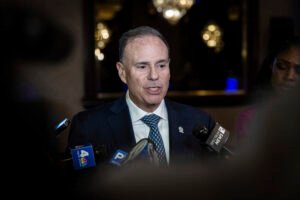
- ‘The US can’t lose’: Pentagon plows ahead on AI despite warnings
- House votes to hold Leon Black in contempt of Congress
- GOP’s gas tax holiday push falters in House
- Bonamici ‘exploring’ bid for Scott’s education leadership
- Ted Cruz: ‘It’s still my hope’ to have an AI markup this month
- Cassidy grills surgeon general pick on vaccines
- Democrat targets Trump’s push for publicly-sited AI data centers
- Leader of House Epstein investigation rolls out bill to protect victims of sexual assault
-

 Politics2 years ago
Former ‘Squad’ members launching ‘Bowman and Bush’ YouTube show
-
Uncategorized2 years ago
Bob Good to step down as Freedom Caucus chair this week
-

 Politics2 years ago
Former Kentucky AG Daniel Cameron launches Senate bid
-

 The Josh Fourrier Show2 years ago
DOOMSDAY: Trump won, now what?
-

 The Dictatorship2 years ago
Luigi Mangione acknowledges public support in first official statement since arrest
-

 The Dictatorship2 years ago
Pete Hegseth’s tenure at the Pentagon goes from bad to worse
-

 Politics2 years ago
Blue Light News’s Editorial Director Ryan Hutchins speaks at Blue Light News’s 2025 Governors Summit
-

 The Dictatorship1 year ago
Mike Johnson sums up the GOP’s arrogant position on military occupation with two words