
Politics
Centrist WelcomePAC charts path for Dems, with help from Axelrod, Plouffe and others

Centrist Democrats have a plan for their party to win again: Talk more about the economy and less about democracy. Reject corporate interests and ideological purity tests. Keep the progressive policies that are popular — like expanding health care and raising the minimum wage — and moderate on issues like immigration and crime.
Those are among the takeaways laid out in an expansive report Monday from WelcomePAC, which supports center-left candidates, on how Democrats can rebound from last year’s electoral wipeout in 2026 and 2028.
The 58-page prescription comes as Democrats continue to war over the direction of their party nearly a year after their national shellacking. And it drops a week before a slate of gubernatorial and mayoral contests that will serve as the first major temperature check of the electorate since 2024 and President Donald Trump retaking the Oval Office.
It features input from a who’s who of top Democratic consultants — including David Axelrod; James Carville; David Plouffe, a top adviser to former Vice President Kamala Harris’ campaign; Lis Smith; and former Biden White House spokesperson Andrew Bates — as well as analysts and strategists like Nate Silver, Sarah Longwell and former Rep. Cheri Bustos of Illinois.
The report is less an autopsy of the 2024 election — it spends a scant five pages on former President Joe Biden’s and Harris’ campaigns — and more so an indictment of the party’s leftward shift since the Obama administration and the donors, campaign operatives and progressive advocacy groups the authors blame for putting Democrats in an unwinnable position.
It largely echoes what moderate Democrats have been saying loudly for months — that the party should be running to the center and focusing on kitchen table issues.
It uses polling data to reinforce the message many centrist Democrats believe voters sent the party in 2024: that voters felt Democrats were prioritizing democracy, abortion and identity over top-of-mind issues like the economy, immigration and crime. It argues that moderate candidates tend to overperform progressive ones, citing centrist Sen. Ruben Gallego (D-Ariz.) and Rep. Jared Golden (D-Maine) as models for how the party should message on border security and the economy.
And Democrats “should distance ourselves from the Biden administration,” the authors write, “particularly by critiquing the Biden administration’s approach to border security and the cost of living.” Harris, they posit, lost in part because of her failure to do so — and because voters couldn’t let go of her past progressive policies even as she ran a more moderate campaign.
The report doesn’t call for a wholesale rejection of progressive stances. Expanding access to public health care, making the wealthy “pay their fair share” in taxes and raising the minimum wage are all popular with voters, and WelcomePAC believes the party should continue to focus on them. Democrats, the authors say, should emulate Sen. Bernie Sanders (I-Vt.), Rep. Alexandria Ocasio-Cortez (D-N.Y.) and Democratic nominee for New York City mayor Zohran Mamdani’s “relentless focus” on affordability.
But they also say Democrats should focus less on “lower-salience issues where our views are unpopular,” such as transgender athletes. They insist that running against the establishment — as is en vogue these days — doesn’t have to mean running toward the left. And they contend that simply running younger candidates “is not a panacea.”
WelcomePAC made no mention of next week’s gubernatorial contests in New Jersey and Virginia. But their strategy will undergo an early test in both states, where the party has put forward a pair of moderate lawmakers with military and national security backgrounds who are running campaigns centered on affordability. Democrats are favored to win both races, though Rep. Mikie Sherrill’s contest in New Jersey is expected to be far closer than former Rep. Abigail Spanberger’s in Virginia.
WelcomePAC warned against drawing conclusions from the elections heading into 2028 in its report, insisting that “doing well in midterms and special elections does not guarantee Democrats anywhere close to the same results in a presidential race” because less-engaged voters tend to skip those intermediate contests.
But Democrats across the ideological spectrum will undoubtedly be scanning the results of next week’s elections in two states that stayed blue in 2024 but shifted toward Trump for signs of what is — and isn’t — working for the party heading into a high-stakes midterm election and the critical presidential contest to follow.


Sen. Jon Ossoff hosted a few hundred donors and supporters for a recent Washington fundraiser — but it wasn’t just for him.
Instead, the Sept. 16 gathering was geared toward raising money for the Democratic Party of Georgia and its coordinated campaign, according to an Ossoff aide and one attendee, who was granted anonymity to describe a private event.
It’s part of his broader effort to boost state Democrats as they look to flip the governor’s mansion for the first time in over 20 years and improve their margins in the legislature. And the timing, just weeks before November, signals confidence in Ossoff’s own reelection prospects and the sizable warchest he’s raised for himself.
This month’s event was the latest of several similar fundraisers Ossoff has held over the last two years. He plans to host more fundraisers for Georgia’s Democratic Party and the coordinated campaign ahead of Election Day, according to one person familiar with his planning, who was granted anonymity to speak candidly.
If his moves are successful and November ushers in historic wins for Georgia Democrats, Ossoff will have cemented his status as a serious leader in the critical swing state. He would hold on to a crucial seat in the Senate as the party looks toward the South to shore up its future. He’d be credited in part with helping elect former Atlanta Mayor Keisha Lance Bottoms as the country’s first Black woman governor. And though Ossoff has said he’s not interested in joining a 2028 presidential race, leading a November sweep would ultimately raise his national profile.
“It would be hard to call him anything but a leader of the [state] party at that point. He’s already inching his way towards that kind of designation,” said Andrew Heaton, a Georgia-based Democratic strategist who supports the ticket. “But if there is the kind of success that a lot of people are predicting for the cycle, he would receive a large portion of the credit for that.”
Ossoff’s campaign did not comment beyond confirming the fundraisers.
The events are just part of Ossoff’s endeavor to help build out the Georgia Democratic Party’s apparatus after a rough 2024 election cycle.
The senator has transferred $3.6 million of his own campaign funds to the party’s coordinated campaign to date, which the Atlanta Journal-Constitution first reported. Since the effort was announced in July, the party has opened 30 field offices across the sizable state, and employs more than 100 field staffers helping with grassroots organizing for races up and down the ballot.
The coordinated campaign is led by a former Ossoff political director, Kyle Tromley. Caroline Saudek, a longtime fundraiser for Ossoff’s political operation, also joined the state party in January in a fundraising-focused role.
Democrats across the state — from the densely populated Atlanta metro to Georgia’s small sliver of Atlantic coast — said they’ve seen a marked difference in the coordinated campaign’s involvement this cycle, from consistent communication to investment in smaller-profile races. That transformation, several noted, started when Chair Charlie Bailey took the helm.
Bailey, an attorney from rural Harris County and former statewide candidate for lieutenant governor, became the leader of the party in mid-2025 with Ossoff’s crucial support.
“It is definitely a stronger coordinated campaign than I’ve seen in years, and in previous cycles. And it feels like it is better staffed, they staffed up earlier,” Heaton, the Georgia-based Democratic strategist, said.
Republicans are also taking note of the newly improved Democratic machine in a state that, until 2020, was a safe-red hold for the most high-profile races. Already, GOP fears are growing about Rep. Mike Collins’ ability to beat Ossoff. And polls show GOP gubernatorial nominee Rick Jackson locked in a tight battle with Bottoms, despite having dropped tens of millions from his own bank account into the race.
Georgia Republican Party Chair Josh McKoon shrugged off Democrats’ fundraising efforts and said he feels “very good” about Republicans’ field resources.
“We’ve had a field program in place for months now. We have field staff on the ground all over the state,” he said in an interview, though he declined to provide details on the size of the Georgia GOP’s paid and volunteer operation.
Others aren’t as dismissive.
“The Democratic Party has deployed resources to hire staff that mobilizes and turns out voters. Republicans have not had this competitive of a race in a while, so they don’t have that type of muscle memory,” said Ryan Mahoney, a longtime Georgia-based Republican strategist.
“The Democrats are in such a great spot,” he added. “It’s because the apparatus has been tested and is working.”
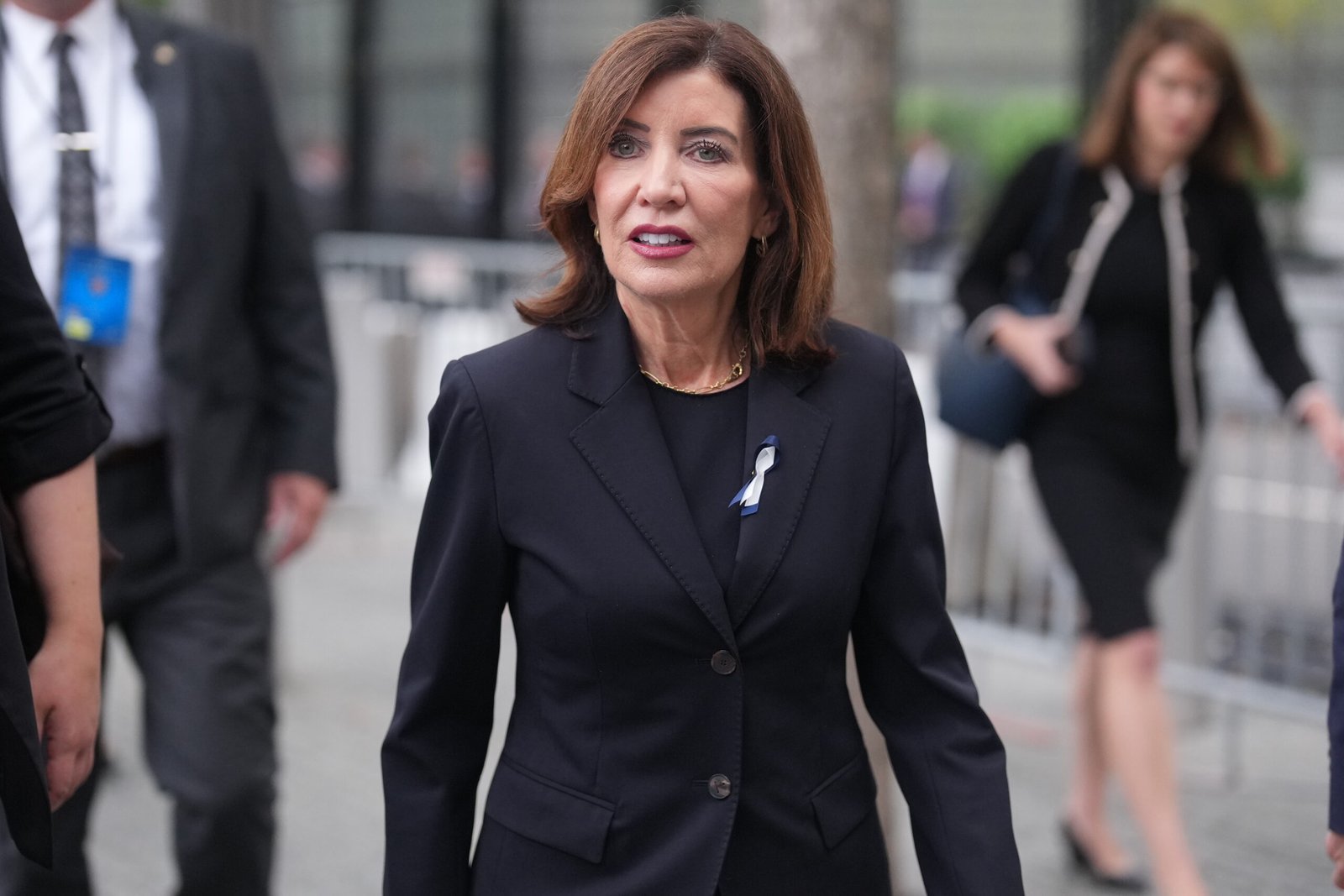

POLICING PROBLEMS: In the early days of his administration, Mayor Zohran Mamdani placed a new requirement on the NYPD: The department would have to secure permission from his office to deploy its Strategic Response Group to make arrests at protests.
The directive, which hasn’t been previously reported, shows Mamdani sought to exert significant influence over a core function of the police department. Its existence also calls into question why the mayor hasn’t more frequently used that authority to stop the SRG from being deployed at protests — since he promised as a candidate to disband the specialized unit.
The unit — which has long weathered criticism for its heavy-handed protest responses — just last week arrested activists protesting Israeli Prime Minister Benjamin Netanyahu’s appearance at the United Nations General Assembly. Several politicians allied with Mamdani were among those put in handcuffs.
When asked about those arrests, an NYPD spokesperson revealed the pre-approval policy to Playbook, confirming that the mayor’s office has the final say whenever the department wants to deploy SRG to detain protesters.
“We communicate with City Hall on this topic as we do on a host of things related to the department,” the spokesperson said.
The police spokesperson declined to comment on when exactly the mayor first instituted the SRG pre-clearance process. But a person familiar with the timing, who was granted anonymity to discuss the sensitive issue, said the policy was put in place during the first few months of Mamdani’s term.
The mayor suggested at a press conference on Monday that he didn’t see a justification for using the SRG in last week’s arrests outside the U.N. “I’ve been clear that my vision is for the disbanding of the SRG,” he told reporters when asked if he thought it was an appropriate use of police resources.
A Mamdani spokesperson declined to comment Tuesday on why the mayor didn’t use his power to call back the SRG last week if he didn’t think its deployment was justified. The spokesperson also would not say if the mayor has ever used his authority to reject a request from the NYPD for SRG intervention.
Amanda Jack, The Legal Aid Society’s policy director for criminal law reform, laced into the Mamdani administration after being informed of the existing policy.
“It is deeply troubling that City Hall has the authority to stop SRG deployments, yet continues to approve them at demonstrations, including at the protests outside the United Nations last week where the mayor himself acknowledged that the deployment was an inappropriate use of police resources,” said Jack, whose group has long advocated for abolishing the SRG. “This further confirms that regulating SRG deployments isn’t the solution. City Hall must finally make good on Mayor Mamdani’s campaign promise to disband SRG for good.”
The future of the SRG is one of several sources of friction between Mamdani and Jessica Tisch, his politically moderate NYPD commissioner. It’s also an issue that the mayor risks disillusioning his leftist base with the longer he keeps dragging his feet on fulfilling his 2025 campaign pledge.
Tisch has defended using the unit, saying it’s a key tool in the department’s network of crime-fighting strategies.
But Mamdani — a democratic socialist who, before launching his 2025 mayoral bid, supported calls to defund the NYPD — has long said the unit should be dismantled. Since taking office, he’s said he’s in active conversations with Tisch about finding a way to break up the unit, but those talks haven’t resulted in any tangible action nine months into his term.
Founded in 2015, the SRG was initially just tasked with counterterrorism work. The group’s responsibilities have since come to include responding to protests that turn chaotic or violent.
In arguing for abolishing the unit, Mamdani and other police reform advocates have pointed to SRG officers racking up disproportionately high rates of misconduct claims while responding to protests.
The SRG was subject to a court settlement in 2023 that put new guardrails around how the unit could be deployed during protests. But Mamdani and like-minded voices have contended that’s not enough and that the SRG should be broken up so it can return squarely to its original counterterrorism function.
In his remarks on Monday, Mamdani reaffirmed that view.
“I have made that promise, I will fulfill that promise,” he said. “The only question is the timeline of it.” — Chris Sommerfeldt
MARK YOUR CALENDAR: Join Blue Light News’s New York Outlook: Affordability, Industry & The Economy on Oct. 14 for live conversations about the business and policy decisions being made today — from City Hall to the State Capitol — that will shape the city’s economic future. The lineup includes New York City Council Speaker Julie Menin, New York City Economic Development Corp. CEO Anthony Shorris, Partnership for NYC CEO Steven Fulop, Citizens Budget Commission President Andrew Rein, Charles H. Revson Foundation President Maria Torres-Springer, and more. Register now to attend in person or watch the livestream.
From the Capitol

CORNELL UNDER FIRE: Gov. Kathy Hochul is calling for an independent review of Cornell University’s response to a 2024 gang rape case, as the case draws national attention and the school faces mounting criticism.
The Tompkins County district attorney said his office is reopening a criminal probe into an alleged gang rape at a Cornell fraternity house, following a civil lawsuit filed by the plaintiff in mid-September.
The plaintiff, a former Cornell student referred to as Jane Doe, alleges in the lawsuit that several men raped her at the Chi Phi house after she was coerced into consuming drugs. The lawsuit names Cornell, several Chi Phi organizations, the former president of Cornell’s Chi Phi chapter, a local bar and unnamed individuals as defendants.
The governor called for outside counsel to conduct a “transparent, independent” review of the university’s response to determine whether Cornell “met every obligation to protect its students and pursue justice.”
“I support the district attorney’s decision to reopen the criminal investigation,” she said in a statement. “But there are also serious questions about Cornell’s campus culture and its systems for prevention, reporting, and response.”
She called the allegations in the case “nothing short of horrifying.”
“For any student to come forward after an experience like this takes extraordinary courage,” Hochul said. “No student should ever be left wondering whether the institutions meant to protect them will listen and act.”
Rebecca Valli, a Cornell spokesperson, told Playbook the school plans to work with the governor and other state officials.
“Cornell shares Governor Hochul’s commitment to addressing campus culture issues, which affect universities across the nation and New York,” Valli said in a statement. “We are committed to continuing to work with state officials to advance student safety and wellbeing.” — Madina Touré
EYES ON AI: When it comes to who’s getting involved in addressing the rapid rise of artificial intelligence, Hochul offered a straightforward perspective today: the more the merrier.
Speaking to reporters after a meeting of her FutureWorks Commission, which is set to deliver recommendations by the end of the year regarding AI and the workforce, Hochul welcomed the City Council’s recently announced moves to regulate AI.
“This is an area where we need an all-hands-on-deck approach,” she said in response to a question regarding whether the Council’s proposals might overlap with the state’s. “I applaud the City Council for getting more information. … If they come up with an idea that would make sense at the state level, we’ll embrace it. We have an idea at the state level, it already covers the city. So this is an area, we’re on the same team in terms of making sure we get this right, because the risks are too high.”
Hochul said the commission is looking to address how AI is reshaping jobs, the best ways to train workers on the technology, protecting those vulnerable to job cuts and “the best ways to harness the benefits of AI for everyday New Yorkers.” Tom Perez, the co-chair of the commission and former U.S. secretary of labor, said there are “more questions than answers at this point” but he has “great optimism that we can tackle this challenge.” — Madison Fernandez
FROM THE CAMPAIGN TRAIL
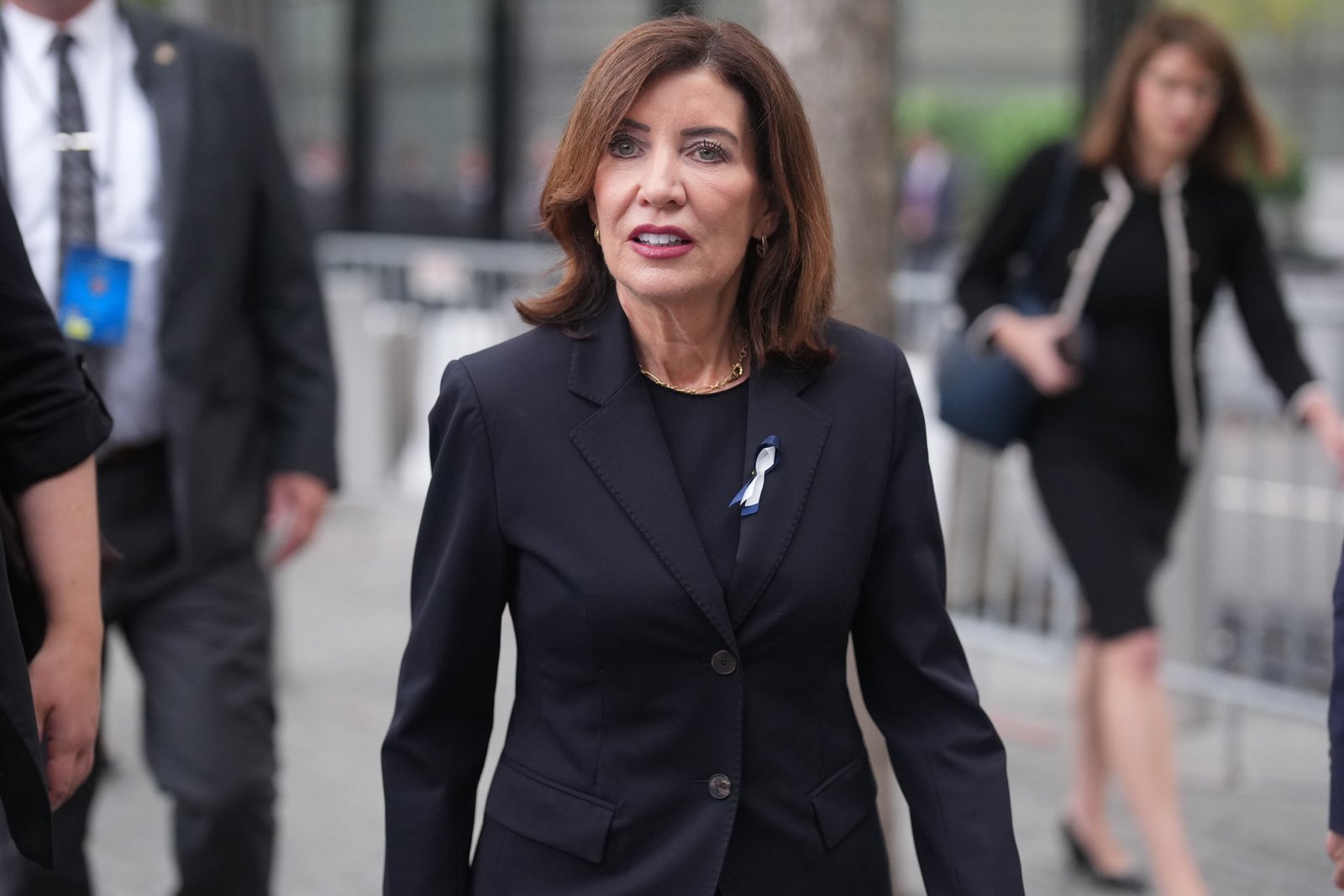
SUPER PAC SURGE: Super PACs backing Hochul have reported $4.8 million in contributions since yesterday, giving the governor a comfortable advantage over Republican Bruce Blakeman in the outside spending arms race.
Greater Empire State, a committee run by the Democratic Governors Association, received $1 million from the Greater New York Hospital Association – a perennial top spender in New York politics that gave the state Democratic Committee $1.5 million in June.
The DGA group also received $500,000 from former gas company CEO John Hess. It reported a dozen four- or five-figure donations from pediatricians and other healthcare groups as well. At least 10 of those have connections to the physician network Somos Community Care, a longtime Hochul benefactor.
Additionally, the landlord-backed New York Apartment Association gave $3 million to Leadership for New York, a pro-Hochul super PAC launched by former NYAA official Jay Martin. That committee subsequently transferred $1 million of its money to the one run by DGA. — Bill Mahoney
BROOKLYN BATTLE: The state Supreme Court’s appellate division ruled in favor of a group of self-described reformers who were looking to unseat Rodneyse Bichotte Hermelyn as chair of the Brooklyn Democratic Party.
The decision comes just hours before the executive committee is scheduled to meet to vote on the next party chair. Julio Peña III, the district leader put forth by reformers to unseat Bichotte Hermelyn, has been locked in a legal battle over Bichotte Hermelyn’s move to change the makeup of the executive committee — a maneuver she claimed would promote inclusivity, but one her opponents insisted was only carried out to pad her support before the leadership election.
A state Supreme Court judge ruled that the vote on the expansion was invalid, but Bichotte Hermelyn appealed the decision. Today’s appellate division ruling voids the expansion — seemingly a win for Peña, who has said he has enough support to win the leadership election under the unchanged structure.
But there’s still plenty up in the air. Last night, Bichotte Hermelyn said she decided not to run for another term as chair. After her announcement, City & State reported that she is backing state Assemblymember Nikki Lucas, who had not been actively running for the position.
Reformers are in court today looking to prevent this evening’s meeting from happening in light of last week’s chaotic organizational meeting. — Madison Fernandez
FROM CITY HALL

COMBAT READY: Mamdani released a highly anticipated blueprint to combat rising antisemitism today amid ongoing criticisms that he’s fueled the problem.
Under his plan, the Mayor’s Office to Combat Antisemitism will weigh in on $26 million that was allocated in this year’s budget to the Mayor’s Office for the Prevention of Hate Crimes, which has a broader mandate to fight all forms of hate.
The cash infusion will mean more money for organizations already engaged in combating antisemitism online and for supporting victims of antisemitic incidents. In particular, the city has doubled the investment in groups doing this work to $6.4 million and has earmarked $1 million for physical security at sensitive sites like synagogues. And it will work to increase visits to the Museum of Jewish Heritage for middle schoolers.
“We hold a responsibility to sustain and protect our Jewish neighbors — a responsibility that belongs to each of us,” Mamdani said in a video message accompanying the report. “That is the work we are undertaking at City Hall, and I am asking every New Yorker to join us.”
While the report generated plaudits from across the political spectrum, several prominent Jewish organizations said the mayor failed to define antisemitism and to acknowledge that some of his own rhetoric is to blame.
“While the Mayor’s plan has a number of positive elements, including some increased security funding for Jewish institutions and expanding proven programs, it fails to address a central issue that the Mayor himself has perpetuated: rhetoric that demonizes and delegitimizes Israel inevitably leads to the targeting of Jewish New Yorkers,” the UJA-Federation of New York, JCRC-NY, AJC New York and New York Board of Rabbis wrote in a joint statement.
Read more from Blue Light News’s Joe Anuta here.
BRIDGE TO HOME: NYC Health + Hospitals is opening a second site for the “Bridge to Home” program, an initiative by former Mayor Eric Adams to provide a place for homeless patients to continue healing after a hospital stay.
Patients will be able to stay as long as 12 months at the new Crown Heights site in Brooklyn, where they will have 24/7 medical support from Woodhull Hospital providers and get help applying for permanent housing.
“Bridge to Home is a bridge between getting well in the hospital and building a life in the community,” Omar Fattal, NYC Health + Hospitals’ chief behavioral health officer, said during a press conference this afternoon. “And for someone like me who spent many years working in inpatient psychiatry, it means that when we ask, ‘Where does this person go next?’, we finally have a better answer.”
Since the first “Bridge to Home” site opened in Midtown Manhattan in September 2025, 18 participants have moved into permanent housing, according to NYC Health + Hospitals.
The first resident of the Crown Heights site, which has capacity for roughly 50 program participants, moves in next week. — Maya Kaufman
IN OTHER NEWS
INFLUENCER ARMY: A group of influencers under instruction from City Hall are reportedly planning a campaign against top New York CEOs, a claim Mamdani’s administration denies. (New York Post)
ENERGY FUTURE: A flurry of new energy-intensive projects are underway in upstate New York. (Times Union)
FRUIT FUMES: Bureaucracy and politics have led to the unraveling of a years-in-the-works plan to modernize a diesel-spewing produce market in the South Bronx. (Gothamist)
Missed this morning’s New York Playbook? We forgive you. Read it here.
Politics
Democrats are running pastors for office. Republicans are attacking their religious comments.
A slate of Democrats are running for Congress leaning on their Christian bona fides. Republicans are trying to portray them as wolves in sheep’s clothing.
In Texas, Republicans are running ads blasting seminarian James Talarico for saying he’s “a Christian who hates Christianity.” In Iowa, they are going after a pair of clergy in key House races as “PINOS” — “pastors in name only,” because they “don’t profess the true gospel of Jesus Christ.” In Kansas, Republicans pan megachurch pastor Adam Hamilton as “too woke and too weak.”
“His sermons are essentially a carbon copy of the Democrat National Committee platform,” said Brent Robertson, chief of staff to Hamilton’s opponent, Sen. Roger Marshall (R-Kansas), pointing to a past sermon in which Hamilton urged followers to reduce their carbon footprint.
The closing arguments on these Democrats — as evidenced by the most recent ads — shows a concerted effort to turn their preaching against them to paint them as fake, corrupt or even blasphemous.
In Texas, MAGA Inc. is on air painting Talarico as a “liberal weirdo,” clipping Talarico’s controversial statements, like “Jesus Christ Himself was a radical feminist” and “God is non-binary.”
The Trump-aligned No Going Back PAC is on air in Iowa’s 2nd District hitting Presbyterian minister and Democrat Lindsay James as inauthentic: “When the cameras are on, Lindsay James goes into a character, a caring pastor who says what you want to hear, but when there’s no spotlight, Lindsay James shows just how radical she can be.”
And in Kansas, GOP Sen. Roger Marshall’s campaign is on air slamming Hamilton as a “slimy,” “millionaire megachurch CEO,” saying he “used faith to fatten his wallet” and “asked churchgoers to pony up for God, then use church resources for his own campaign.”
“The swamp’s got enough money changers,” the ad says.
The attacks are coming precisely because these candidates have proven to be formidable candidates in purple to red areas, using their faith backgrounds to bolster themselves against GOP accusations that they’re out of their state’s mainstream. Talarico poses Democrats’ best chance to flip a Texas Senate seat in nearly four decades. Hamilton has turned deep-red Kansas into a battleground. And James and Sarah Trone Garriott, a Lutheran minister, are running tough in a pair of Iowa districts Trump won in 2024.
Voters “understand and appreciate authenticity, and they know that faith without works is dead,” said Chaz Molder, the Democratic nominee in Tennessee’s deep-red 2nd District who leads a Sunday School class with his wife. “And just posting scripture on Sunday morning to point out that they went to church is not enough.”
But with Democrats’ clerical credibility comes a practical challenge: years and years of on-camera sermons, a treasure trove for oppo researchers. It’s become a challenge in Hamilton’s race, where Vice President JD Vance joined the pile-on earlier this month: During a visit to Iowa, he took a shot at Hamilton as having “kind of a ‘gee whiz, I’m a nice pastor’ vibe,” but said he “tells his congregation not about the gospel of Jesus Christ, but that they need to repent for their white privilege while eating beef.”
Democrats have largely brushed off the attacks. Talarico has said he’s “missed the mark” on some of his “cringey” past comments, but has doubled down on his sermonizing: “When I take on the politicians who are serving themselves and not the people, I’m doing it on biblical grounds,” he said in a sermon last weekend. A James spokesperson criticized Republicans for “desperately attacking Lindsay’s deeply held faith commitments. If it wasn’t so insulting to other Iowa Christians, it would be laughable.” Hamilton has seen clergy run to his side: 120 fellow Methodist ministers across Kansas wrote an open letter to Marshall telling him to stop attacking Hamilton’s pastoral ministry, saying the attacks “tear at the fabric that is the body of Christ.”
“We’re not the first Christians to be attacked for our faith, and we won’t let smears and lies from a couple of Washington politicians stop us from living out our values in the world,” Hamilton said in a video after Vance’s speech.
In many ways, this election marks something of a faith resurgence for the Democratic Party. While only half of Democrat- and Democrat-leaning U.S. adults identify as Christian (a 24-percentage-point decline since 2007), Democrats this cycle are running clergy, Sunday School teachers, chaplains and other devout Christians across the map.
“As a person of faith, I think that it’s time for the Democratic Party to reassert that Democrats are a big tent, and we have many elected officials from different faiths for whom faith is something very important to them,” said Ben McAdams, the Democratic nominee in Utah’s 1st District and a volunteer Sunday School teacher in his Latter-day Saint congregation in Salt Lake City. “The Republican Party of Donald Trump does not seem to be reflecting the Christian values that I grew up with.”
Doug Pagitt, executive director of progressive group Vote Common Good, counts nine clergy running for federal office this cycle as Democrats — something he hasn’t seen before.
“The idea that a faith leader, especially a white faith leader, would run as a Democrat and be forthright about it … it’s really unusual,” Pagitt said. “We’ve had candidates [in the past] whose moms were pastors, and they were nervous about mentioning that in the Democratic Party circles. But that seems to have shifted and changed.”
- Trump set to unveil $54B South Korean investment in Alaska LNG
- Eric Schmitt defends mix-up that led to viral gaffe during Jack Smith’s hearing
- Senate Democrats block House-passed bill restricting member stock trading
- Thune’s ‘difficult’ recon update
- Capitol agenda: One day more?
- Jon Ossoff’s hosting fundraisers — and they’re not all for his reelection campaign
- States look to cut fuel prices — and win the messaging game
- Brian Fitzpatrick’s campaign ads feature damning news headlines. They’re not from an unbiased source.
- A cure for ‘medical tyranny’: RFK Jr. puts a positive spin on AI
- Democrats gear up to tank data center legislation
-

 Politics2 years ago
Former ‘Squad’ members launching ‘Bowman and Bush’ YouTube show
-
Uncategorized2 years ago
Bob Good to step down as Freedom Caucus chair this week
-

 The Josh Fourrier Show2 years ago
DOOMSDAY: Trump won, now what?
-

 Politics2 years ago
Former Kentucky AG Daniel Cameron launches Senate bid
-

 The Dictatorship2 years ago
Pete Hegseth’s tenure at the Pentagon goes from bad to worse
-

 The Dictatorship2 years ago
Luigi Mangione acknowledges public support in first official statement since arrest
-

 Politics2 years ago
Blue Light News’s Editorial Director Ryan Hutchins speaks at Blue Light News’s 2025 Governors Summit
-

 The Dictatorship1 year ago
Mike Johnson sums up the GOP’s arrogant position on military occupation with two words