
Congress
Hakeem Jeffries is seizing on the shutdown fight to raise his national profile

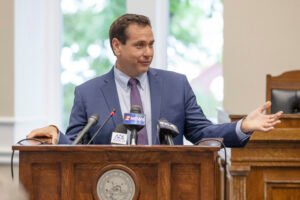
Hakeem Jeffries has spent nearly three years in relative anonymity as House minority leader. Now the New York Democrat is treating the government shutdown fight as a potential breakout moment.
Shedding his reputation as a cool, careful and sometimes overly calculating leader, Jeffries has staked out a much more aggressive approach in recent weeks as he and Senate Minority Leader Chuck Schumer careened into a confrontation with President Donald Trump and congressional Republicans.
While the GOP leaders have so far been more eager to dog his fellow Brooklynite — calling it a “Schumer shutdown,” for instance, after Senate Democrats withheld their votes for a House-passed stopgap bill — Jeffries has made conspicuous moves to make himself a main character in the standoff.
More precisely, he has tried to pick a fight with Trump — first accusing him of not knowing his name, then calling a deepfake video the president posted depicting Jeffries in a sombrero and mustache “racist,” demanding Trump address any further criticism“to my face,” and telling Trump budget chief Russ Vought to “get lost,” among other attacks.
“The president has been engaging in irresponsible and unserious behavior, demonstrating that all along, Republicans wanted to shut the government down,” Jeffries told reporters Wednesday, shortly before he posted a unflattering meme of Vice President JD Vance on his X account.
The tenor of his sparring has contrasted with that of Schumer, who has steered away from calling the deepfake video racist and has instead called it part of a “tantrum” that proves Trump is not serious about negotiating an end to the shutdown. It’s also a departure from Jeffries’ predecessor, former Speaker Nancy Pelosi, whose favored tactic in dealing with Trump was the cutting offhand remark.
But Jeffries’ more bombastic approach is winning praise from elements of the party that want to see more fight out of their leaders.
“They are in the minority over there, and they’re a majoritarian body where the minority has very little voice in terms of affecting the outcomes of events like this,” said Sen. Cory Booker (D-N.J.). “And so he’s showing what an oppositional party leader should do — a lot of fight, a lot of strength — and frankly, the ability to keep Democrats united on the other side of the Capitol.“
Whether he has earned the respect that he so clearly seeks remains unsettled. Trump still has yet to utter Jeffries’ name in public. He referred to him Tuesday to reporters as “a very nice gentleman who I didn’t really know — you know who I’m talking about.”
But after posting the first AI-generated video Monday that had Schumer doing all the talking and Jeffries simply appearing mustachioed in the background, Trump posted another video Tuesday solely starring a deepfaked Jeffries.
Vance chimed in Wednesday from the White House: “I will tell Hakeem Jeffries right now, I make a solemn promise to you that if you help us reopen the government, the sombrero memes will stop.”
Trump might be forgiven for not having Jeffries’ name on the tip of his tongue. Unlike with Schumer — whom Trump has known for decades and was a frequent sparring partner during his first term — Jeffries had no substantial interaction with the president before Monday’s Oval Office meeting.
As House minority leader, he holds the least power of the four top congressional leaders — unlike senators, Democrats in the chamber can be completely sidelined by a united GOP majority — and he is not well known nationally.
Just under half of Americans have never heard of him, according to a recent Pew Research Center poll, versus about a quarter for Schumer, who has held his top position since 2017. Before Pelosi stepped down from a 20-year run as the top House Democrat, only 3 percent of Americans surveyed told Pew they’d never heard of her.
Ahead of the sitdown, Jeffries spoke about Trump with an ally who has long experience dealing with the president — civil rights leader Al Sharpton. He said in an interview that in the weekend conversation that otherwise focused on the New York City mayoral race, Jeffries said he didn’t know what to expect out of the meeting.
“I told him I’ve been fighting with Trump for 35 years, from the Central Park Five all the way through, and [that] sometimes he tried to act nice,” Sharpton said. “I said, ‘I find him to be a day trader — he says whatever will work to his advantage at that particular time. I don’t think Donald Trump believes in anything but Donald Trump.’ And Hakeem kind of chuckled.”
After walking out of the White House, Jeffries hewed closely to health-care-focused talking points that he and Schumer have carefully honed since infamously diverging on a prior GOP-written spending bill back in March.
Then Trump posted the AI-generated video, and Jeffries let loose, calling it “bigoted” and then “racist and fake.” It was a response that stunned some of his colleagues, who agreed with the assessment but also knew Jeffries had long counseled Democrats not to take Trump’s “bait.”
Rep. Emanuel Cleaver (D-Mo.), a longtime Jeffries ally, said it was the first time he’d ever heard the leader call a personal attack “racist.”
“I was furious, and no one would blame the leader if he said I didn’t want to be around this guy or get somebody else to take my place to interact with the White House,” Cleaver said. “He’s going to be a professional about it.”
“It was blatant. It was personal. It was insulting. And I think that Hakeem had to respond for his own self-respect,” added Sharpton.
Asked about Jeffries’ response, White House spokesperson Abigail Jackson said, “Anyone who’s feigning outrage over a perfect meme should instead focus on the countless Americans who will suffer as a result of the Democrat shutdown.”
That Jeffries mounted a more aggressive response than Schumer to Trump’s attacks is of little consequence in terms of the shutdown fight. Besides his own personal feelings, some Democrats noted it reflects the more rough-and-tumble style in the House and voters’ desire for a more pugilistic approach to Trump.
But there have also been small tactical differences between the two leaders that could get magnified as the standoff wears on. Notably, Jeffries has staked out some harder lines than Schumer — insisting, for instance, that any health care agreement be in writing and attached to any bill reopening the government, while Schumer has left room to cut an unwritten side deal.
One prominent House Democrat believes Jeffries has been handling himself well.
“He has seized the moment,” Pelosi said in a brief interview. “He’s doing a great job. I have no guidance for him except to keep on doing what he’s doing.”
Jennifer Scholtes contributed to this report.


Democratic efforts to revamp the Supreme Court gained momentum Thursday as an influential center-left think tank released a plan to limit justices’ terms and misconduct.
Third Way’s proposal, shared first with Blue Light News, highlights growing unity across the ideological spectrum in the Democratic Party for significant changes to the high court as Americans’ trust in the institution hovers at historic lows.
The group says it also wants to inject ideas to overhaul the court — including legislation to set an 18-year term limit and an enforceable ethics code — into the party’s conversations leading up to the 2028 presidential race.
“This is one of those things that we think can and should be a part of the 2028 discussion, and those folks who are running should be asked about whether they would champion Supreme Court reform,” Lanae Erickson, a senior vice president at Third Way, said in an interview.
Key Democratic groups have increasingly been coalescing around ideas to overhaul the court’s structure and policing in light of accusations of growing partisanship and corruption among justices. In June, a number of key Democratic House caucus leaders, including the Congressional Progressive Caucus, released their own resolution calling for term limits for justices and a code of ethics.
“We think that the center left has been remiss in not being forward enough on reform proposals that would make our system work better for people, which is why some folks have gone to the further left,” Erickson said.
Third Way cited public opinion polling from both the Brennan Center for Justice and FOX News indicating more than 70 percent of respondents favored term limits for justices. An 18-year cycle would ensure the appointment of two justices every presidential term.
The group also wants legislation to hold justices accountable for ethics violations. House Minority Leader Hakeem Jeffries said last month he supports “dramatic reform” on the Supreme Court starting with an ethics code so justices don’t act “above the law.”
The court in 2023 adopted its own formal ethics code for the first time in history, but that policy largely lacks some of the teeth that advocates have proposed.
One idea supported by some Democrats that Third Way is not endorsing: upping the number of justices on the bench. Erickson said that idea seems more like “a mutually assured destruction path,” as parties could go back and forth adding more justices.
The path forward for any court-focused legislation in Congress in the near future, however, is very slim without majorities in both chambers and control of the White House — something Third Way acknowledged.
Still, the group’s recommendations are meant “to show that the center left can also be bold and be addressing systemic problems to appeal to voters and their level of anxiety and anger about what’s happening right now,” Erickson said.
The Senate wrapped up its work late Wednesday night, and lawmakers in both chambers won’t be back until after midterm voters pass judgment.
And Chuck Schumer is growing increasingly confident they’ll hand the Senate to Democrats
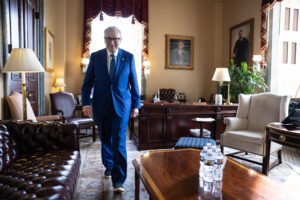
“Here’s how I’d sum up the election: Can enormous amounts of Republican money beat a Democratic enormous advantage in much better candidates and a much better political climate?” the minority leader said in an interview in his office Wednesday.
“I think we win,” he added.
Schumer’s optimism — saying Democrats’ have the “wind in their sails” — reflects his members’ growing bullishness as they head home for a final sprint to convince voters to give them back the majority. The Senate recessed Wednesday night after confirming President Donald Trump’s Labor secretary, but Democrats stayed united in a string of politically tricky votes before leaving.
“It certainly feels like it’s going to be a wave election, and not for good reasons,” Sen. Chris Murphy said. “This president’s domestic and foreign policy has gone off the rails.”
There’s division among Democratic party strategists on whether to spend these final weeks focusing on the states viewed as most likely to flip — like Alaska, Ohio or Iowa — or put resources into so-called reach states like Mississippi, South Carolina or Florida.
Schumer declined to weigh in, but said that Democrats would do “whatever it takes to win” and that he expects to spend the next five weeks fundraising.
“We have lots of different paths to victory, and we’re not going to turn any of them down,” he said.
Also hanging over the midterm elections are questions about Schumer’s future — but the New York Democrat said that he is “running for re-election for leader. Period.”
Republicans, meanwhile, are still hopeful that they can hold onto their majority even if it’s narrower. Much of the midterms map runs through states that Trump won previously.
“Of course we are,” Senate Majority Leader John Thune said about keeping control of the chamber as he left the building Wednesday. “Thank you for asking.”
What else we’re watching:
— PERMITTING DEAL FACES HOUSE BUZZSAW — The Senate’s newly announced bipartisan permitting reform package is set to hit a wall in the House, where key lawmakers aren’t rushing to endorse it. House Natural Resources ranking member Jared Huffman warned Wednesday most House Democrats will not support the Senate’s permitting legislation as written, urging lawmakers to resume negotiations after the midterm elections when they are “likely to have a far better negotiating position.” And House Energy and Commerce Chair Brett Guthrie, a key GOP negotiator, has yet to take a position on the Senate deal.
—RASKIN WANTS TRUMP AD PROBE — House Judiciary’s top Democrat is demanding federal inquiries into the amount of taxpayer money that was used by the Trump administration for a TV ad blitz endorsing the president ahead of the midterms. Rep. Jamie Raskin, who is poised to lead the panel if Democrats flip the chamber, and Rep. George Whitesides, wrote to the Government Accountability Office Wednesday asking them to investigate the “source, accounts and total amount of taxpayer funds used” to produce and distribute the ads. The pair of lawmakers also asked the Office of Special Counsel to investigate whether the ads “constitute a violation of the Hatch Act” and to “determine who should be held accountable.”
Nico Portuondo and Chris Marquette contributed to this report.
The top Democrat on the House Judiciary Committee is demanding federal inquiries into the amount of taxpayer money used to furnish a television ad blitz propping up President Donald Trump ahead of the midterms.
Rep. Jamie Raskin of Maryland, who is poised to lead the panel if Democrats win the majority in November, joined California Democratic Rep. George Whitesides in sending a letter to the Government Accountability Office and the Office of Special Counsel. It asks the GAO to investigate the “source, accounts, and total amount of taxpayer funds used by the Executive Office of the President to produce and distribute this advertisement across major television markets and official White House social media channels.”
The lawmakers also ask the Office of Special Counsel to investigate whether the ads “paid for by millions of dollars of taxpayer funds, constitute a violation of the Hatch Act, and determine who should be held accountable.”
The ads, which so far have run during NFL games and flagship Sunday news shows, depict Trump in a powerful and effective light, with glimpses of him posing for the camera, denigrating the free press and denouncing communism. Each includes the phrase, “paid for by the U.S. government.”
“These ads constitute an illegal use of taxpayer funds, perhaps best demonstrated by the fact that they are virtually identical to the ones Donald Trump used during his 2024 presidential campaign, and in fact use the same footage and the same inept ideological messaging,” Raskin and Whitesides contend.
Other congressional Democrats have also reached out to the administration in recent days to express outrage and ask basic questions about how the ads were derived and funded.
Sens. Patty Murray of Washington and Chris Murphy of Connecticut — the top Democrats on the Senate Appropriations Committee and the appropriations subcommittee on Homeland Security, respectively — have written to Homeland Security Secretary Markwayne Mullin regarding reports that the agency has redirected $20 million in funding originally intended for Customs and Border Protection to “bankroll the obscene political ads.”
A White House spokesperson called the TV spots “public service announcements” and said they are designed to remind “Americans to love their country and understand what makes it worth defending, at home, at our borders, and abroad. The ad is educational and unapologetically patriotic. We should be proud of our country.”
A spokesperson for DHS said the agency “follows all applicable rules for contracting decisions and keeps all decision makers informed” and that “all contracting decisions are made in accordance with applicable law.”
The Office of the Special Counsel confirmed it received the letter and declined comment.
A spokesperson for GAO did not respond to a request for comment.
- Senate bipartisan permitting deal faces a House buzz saw
- Centrist Dem’s Supreme Court plan boosts momentum for revamp
- Republicans need Trump to turn out the base. Some candidates still don’t want him.
- Democrats’ mail-voting plans shift as officials work to reassure voters
- Bipartisan Senate duo drops new data center bills
- Raskin leads calls for federal investigation into Trump PSA’s
- Capitol agenda: Dems skip DC with wind in their sails
- ‘I think we win’: Schumer sets the tone as Senate Democrats grow more confident about November
- Ron Johnson blocks vote to stop Trump’s funding cancellations
- Trump says diesel export ban is still on the table
-

 Politics2 years ago
Former ‘Squad’ members launching ‘Bowman and Bush’ YouTube show
-
Uncategorized2 years ago
Bob Good to step down as Freedom Caucus chair this week
-

 The Josh Fourrier Show2 years ago
DOOMSDAY: Trump won, now what?
-

 Politics2 years ago
Former Kentucky AG Daniel Cameron launches Senate bid
-

 The Dictatorship2 years ago
Pete Hegseth’s tenure at the Pentagon goes from bad to worse
-

 The Dictatorship2 years ago
Luigi Mangione acknowledges public support in first official statement since arrest
-

 Politics2 years ago
Blue Light News’s Editorial Director Ryan Hutchins speaks at Blue Light News’s 2025 Governors Summit
-

 The Dictatorship1 year ago
Mike Johnson sums up the GOP’s arrogant position on military occupation with two words