
Congress
Democrats make a Trump-inspired U-turn on redistricting

The last time House Democrats held the majority, they made a sweeping package of good-government reforms — including an attempt to end partisan gerrymandering — a centerpiece of their legislative agenda.
“The people should choose their politicians,” then-Speaker Nancy Pelosi said in 2021, moments before the House passed the bill that would later die in the Senate. “Politicians should not be choosing their voters.”
Now, as President Donald Trump pushes Republicans in red states to redraw congressional district lines to their benefit, some Democrats are abandoning their past push for reforms. Instead, they’re cheering on leaders like California Gov. Gavin Newsom who say their party must fight fire with fire.
Pelosi, in a statement to Blue Light News, said she backs Newsom’s effort to overrule a bipartisan California map and counter GOP attempts to “rig the elections in their favor.”
Her U-turn is emblematic of the larger rethinking underway within the Democratic Party, where leaders who once embraced anti-gerrymandering initiatives and feared a race to the bottom in partisan warfare between red and blue states are now increasingly willing to set aside their lofty goals — at least temporarily.
It’s another facet of the dilemma that’s vexed Democrats since Trump first won the presidency. They’ve tried to present themselves to voters as “adults in the room” willing to set aside partisanship for the public good. But now that they’re being confronted with a potential existential threat to regaining power in 2026 or beyond, they’re entertaining bare-knuckle tactics.
That includes some groups who have long advocated for high-minded changes to the political system, such as the National Democratic Redistricting Committee, a group founded in 2017 by former Attorney General Eric Holder.
“This organization is taking a posture that we’re not going to oppose states taking corrective and temporary measures,” said its president, John Bisognano.
And it’s happening in the House, too, where the reform agenda promoted under Pelosi has fallen by the wayside. While Minority Leader Hakeem Jeffries and members of his leadership team continue to advocate for voting rights advancements and other key policies, they’ve not made them central to their opposition to Trump and his Republican allies in Congress.
Rep. Joe Morelle (D-N.Y.), the top Democrat on the committee overseeing federal elections, called Trump an “anomalous figure” requiring an emergency response — including when it comes to gerrymandering.
“I will be an advocate for continuing to try to create national standards, but until those national standards are agreed to by everyone, I think it’s going to make it increasingly difficult for states to continue to engage in a more nonpartisan system of redistricting,” he said in an interview. “As with so many things, Donald Trump shatters the norms and the standards that we have lived for, and as we try to improve our democracy, he is just shattering it. We have no choice but to respond in kind.”
The rethinking has been prompted by Texas Republicans’ decision to respond to Trump’s push to launch an unusual mid-decade redrawing of congressional lines in a special legislative session called last month by GOP Gov. Greg Abbott. The effort is now on hiatus with Democratic state lawmakers having fled the state to deny Republicans a quorum in protest of what they see as a partisan power grab.
Other Republican-controlled states such as Missouri, Ohio and Indiana could follow Texas’ lead and rework their own congressional maps to shore up the three-seat House GOP majority ahead of next year’s midterm elections.
Confronted with claims of partisan overreach, Republicans gladly point to Democratic states that have drawn their own gerrymanders. Illinois’ 14-3 map in a state where Trump won 44 percent of the vote has been excoriated by good-government advocates. New York’s move to sidestep an independent map ended up in the courts and threw the 2022 midterms into chaos.
Democratic Rep. Mike Quigley, asked by a Blue Light News reporter Thursday at an event in his hometown of Chicago, said he is “aware that our maps in Illinois are gerrymandered.”
“Look, in an ideal world, these maps are drawn by nonpartisan commissions, and they represent what the Constitution said we should do,” he said. “We’re not there yet. … So you can’t be a Boy Scout in a situation like this — you have to be as tough as they are.”
Enter Newsom, who has triggered the effort to expand Democrats’ advantage in California by overriding the map and sifting as many as five seats away from Republicans — which could entirely offset the Texas redraw.
The effort has rekindled the war over redistricting inside the Golden State, which has been done by an independent citizens commission since a successful 2010 ballot initiative. Before the vote, Pelosi and other prominent California Democrats — including then-Rep. Adam Schiff, then-state Sen. Alex Padilla, who are now both U.S. senators — opposed stripping line-drawing power from elected officials and backed a measure to maintain state lawmakers’ control.
Foes of independent California redistricting, like Pelosi, tried to persuade voters it wasted tax dollars on unaccountable bureaucrats. But their opponents countered that officeholders were motivated to protect their turf.
“Elected officials don’t like to change the system that got them elected unless they can be super sure about what comes out of that and that they’re going to be okay,” said Eric McGhee, a Public Policy Institute of California expert who has written extensively about redistricting.
Only later did California’s most prominent Democrats embrace independent redistricting as a national matter. Now, they’re back on familiar ground, defending their party’s right to undertake its own power play in the face of GOP efforts elsewhere.
“While we continue to support enacting legislation to create nationwide independent redistricting commissions, Democrats must respond to Republicans’ blatant partisan power grab,” Pelosi said in her statement. “Democrats cannot and will not unilaterally disarm.”
Her fellow House Democrats don’t have any remorse about the political capital spent trying to pass the voting rights legislation in previous Congresses, though some are wistful about their failure in light of their current predicament.
Both their sweeping campaigns-and-elections package, dubbed the For the People Act, and a narrower measure aimed at restoring the 1965 Voting Rights Act, named after the late Rep. John Lewis, ran headlong into the Senate filibuster and now have zero path to passage under the GOP trifecta.
“This is an example of why we need it,” said Missouri Rep. Emanuel Cleaver, whose Kansas City–area district could be redrawn by the state GOP in the coming weeks.
Quigley said that Democrats should continue “pushing and advocating” for national redistricting standards, “educating the public of where we can be and why it matters” — even as they pursue their own partisan lines.
Rep. Jamie Raskin of Maryland, the top Democrat on the Judiciary Committee, also argued for reviving Democrats’ voting bills in a future Congress and for eventually going even further by implementing multi-member congressional districts and ranked-choice voting.
But he acknowledged the reality of the situation Democrats face.
“I would rather fight fire with water and put gerrymandering out of business,” he said. “But if the Republicans are going to plunge us into a race to the bottom, then we have to fight back with every means at our disposal.”
Shia Kapos, Nicole Markus, Jeremy White and Liz Crampton contributed to this report.


Congress
Trump apparently shares Tom Cotton’s phone number in push to make Daylight Saving Time permanent
President Donald Trump appeared to share Sen. Tom Cotton’s phone number in a Saturday morning social media post imploring the Arkansas Republican to get behind a bill to make Daylight Saving Time permanent.
“Almost everybody wants “The Sunshine Protection Act” to pass, except for Tom Cotton,” Trump wrote on Truth Social. “To the Great People of Arkansas, please let your Senator know it would be a GREAT Bipartisan WIN for the United States Senate, and for America, itself.”
The president has spent months personally pushing Senate Republicans to end the practice that sees Americans change their clocks twice a year, cementing more sunlight hours in the evening for all twelve months of the calendar. Cotton, whom Trump called “a friend of mine” in the Saturday post, has long argued that making daylight saving time permanent would leave children, farmers and other early risers in the dark for hours on winter mornings.
One of Trump’s key selling points on Saturday: the PGA tour.
“The PGA TOUR, as an example, needs more Daylight in the afternoon in order to finish their Tournaments,” he said, attaching a letter from PGA Tour CEO Brian Rolapp endorsing the bill. ”Likewise, regular Golfers, Tennis Players, Hunters and, perhaps most importantly, Farmers who want more Daylight to play or work.
A Blue Light News call to the cellphone number went to voicemail. A spokesperson for Cotton did not respond to a request for comment. The White House did not immediately respond to a request for comment.
The current version of the bill was introduced in the House in January 2025 by Rep. Vern Buchanan (R-Fla.), with Sen. Rick Scott (R-Fla.) leading the Senate version. The legislation would make daylight saving time permanent across most of the country, ending the twice-yearly clock changes. The legislation has been stalled in the Senate since July.
The president encouraged supporters of the bill, dubbed the “The Sunshine Protection Act,” to call Cotton to “let your Senator know it would be a GREAT Bipartisan WIN for the United States Senate, and for America, itself.”
During the 2016 Republican presidential primary, he publicly gave out the personal cellphone number of then-rival Sen. Lindsey Graham after the South Carolina Republican criticized him. Trump, who came to count on Graham as a reliable Senate ally after he won the presidency, revisited the moment during Graham’s funeral in July, acknowledging that sharing the number was something he “shouldn’t have done.”
Kelsey Brugger contributed to this report.
Sen. Bernie Sanders will hit the road for Troy Jackson in Maine starting Oct. 10, the first time the progressive leader will stump for the candidate this cycle.
The Vermont independent plans to hold three rallies with Jackson, according to an itinerary shared first with Blue Light News: first in Bangor on Oct. 10th followed by Lewiston and Biddeford on Oct. 11.
The Maine swing will kick off Sanders’ travel for the final stretch of the midterms, covering ground throughout October for House and Senate candidates, POLITICO reported.
“Bernie and Troy know that working people built this country and deserve a government that fights for them,” Jackson spokesperson Dan Gottlieb told Blue Light News. “Susan Collins has had nearly 30 years to deliver, and working Mainers are still getting squeezed while she serves the billionaires and corporate interests who bankroll her campaigns. Mainers don’t need another six years of excuses.”
Sanders campaigned ahead of major wins for progressives in the primary season, speaking at more than 60 rallies since last year’s Fight the Oligarchy tour and endorsing more than 90 candidates up and down the ballot.
He’s also opening his substantial $23 million campaign war chest, POLITICO reported, and contributing hundreds of thousands of dollars toMinnesota Lt. Gov. Peggy Flanagan’s Senate campaign and others including Angie Nixon in Florida and Minnesota Attorney General Keith Ellison,
Sanders will return to Maine after initially backing Graham Platner’s campaign for Senate. Allegations reported by POLITICO ultimately led him to call on the Democratic nominee to drop out of the race.
Sanders had not formally endorsed Jackson since he clinched the nomination from Platner, though he previously backed Jackson’s initial run for governor.
House Financial Services Chair French Hill said he has “no concerns” about winning back his Arkansas seat in the upcoming midterm elections, but the six-term House member acknowledged the political headwinds for his party.
“I consider the atmosphere a very tough political environment right now because of President [Donald] Trump’s lack of favorability at the top, and you know people are concerned about, as I say, what it’s like to live under an inflated economy the last four years,” Hill said in an interview.
Hill is in a solidly red district, according to the nonpartisan Cook Political Report, and said he is up against a “weaker candidate this time than I’ve had in past races.” Polling in the district, however, has shown a tighter race. The two polls done this year placed Democratic challenger Chris Jones ahead of Hill by a few percentage points. Any perceived polling victory for Jones is still well within the margin of error, and one of the polls had a Democratic sponsor.
Stephannie Lane Baker, a spokesperson for Jones, said that “of all the Republicans in Congress, the chairman of the Financial Services Committee doesn’t get to dodge responsibility for this economy. He’s in trouble, and he knows it.”
Additionally, Illinois Gov. JB Pritzker’s PAC, Ready for the Fight, committed more than $1 million in television ads through the next five weeks for Jones’ race in Arkansas’s 2nd District, Jordan Abudayyeh, a spokesperson for the PAC confirmed. Overall Democratic spending on advertising for the race was just over $1 million, primarily made up by contributions from the Ready for the Fight PAC, with Republicans spending almost $2.7 million on ad buys, according to AdImpact, an advertising tracking service.
Hill said he has addressed affordability concerns “head on” this Congress.
“My work on housing, my work on the Price Stability Act, my work to try to reduce waste, fraud, and abuse, and drop the federal budget deficit as a percentage of GDP,” Hill said. “All these things can contribute to a more affordable environment for people. So I’ve tried to make that a forefront of my campaign this year.”
Hill was a key architect of the 21st Century ROAD to Housing Act, a bipartisan housing affordability bill that became law in July. The Price Stability Act, which is unlikely to become law this year, would narrow the Federal Reserve’s current dual mandate of pursuing maximum employment and price stability to focus exclusively on containing inflation.
- RFK Jr.’s movement is in disarray
- Ted Cruz blasts JD Vance as ‘insecure,’ says he’s focused on helping GOP win midterms
- Republicans don’t have a clear boogeyman for this year’s midterms
- Republicans tried to punt health care cuts until after the midterms. It didn’t work.
- Trump apparently shares Tom Cotton’s phone number in push to make Daylight Saving Time permanent
- ‘A slow-moving car crash:’ Republicans are wary of the $200 million-plus price tag to save Ken Paxton
- Trump rules out diesel export ban after Europe agrees to tap stockpiles
- Sanders to rally for Troy Jackson in Maine
- Hill: Trump’s ‘lack of favorability’ creating challenging politics
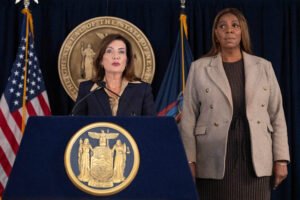
- Hochul eyes changes to state’s rape law amid Cornell crisis
-

 Politics2 years ago
Former ‘Squad’ members launching ‘Bowman and Bush’ YouTube show
-
Uncategorized2 years ago
Bob Good to step down as Freedom Caucus chair this week
-

 The Josh Fourrier Show2 years ago
DOOMSDAY: Trump won, now what?
-

 The Dictatorship2 years ago
Pete Hegseth’s tenure at the Pentagon goes from bad to worse
-

 Politics2 years ago
Former Kentucky AG Daniel Cameron launches Senate bid
-

 The Dictatorship2 years ago
Luigi Mangione acknowledges public support in first official statement since arrest
-

 Politics2 years ago
Blue Light News’s Editorial Director Ryan Hutchins speaks at Blue Light News’s 2025 Governors Summit
-

 The Dictatorship1 year ago
Mike Johnson sums up the GOP’s arrogant position on military occupation with two words